|
Getting your Trinity Audio player ready...
|
The Complete Guide to Writing a Memoir
Every person alive has a story. A moment that changed everything. A season of life that was hard, beautiful, confusing, or all three at once. Most people carry that story around inside them for years, wondering if it is worth writing down.
When you write a memoir, you are not just putting words on a page. You are handing someone else a window into your world. You are saying, “This happened to me. Maybe it happened to you too.” That kind of honesty is what makes the most engaging memoirs impossible to put down.
But here is where most people get stuck. They want to write it, but they do not know where to begin. They think their story is not big enough, not dramatic enough, or not interesting enough. None of that is true. The only requirement for writing a great memoir is that you lived through something real and you are willing to share it honestly.
This guide will walk you through the entire book-writing process from finding your story to getting it published and into the hands of readers. Step by step. No confusion. No hard words. Just a clear and honest path forward.
What Is a Memoir and How Is It Different From an Autobiography
A lot of people mix these two up, so let us clear it up quickly.
An autobiography tells the story of your whole life, from beginning to where you are now. A memoir focuses on one specific part of your life: one chapter, one relationship, one journey, one turning point.
When you write a memoir, you are zooming in. You are not trying to cover everything. You are picking the part of your life that carries the most meaning and exploring it deeply. That focus is what makes memoirs so powerful and so personal.
Think of it this way. An autobiography is a full photo album. A memoir is one photograph, blown up large enough to see every detail.
Why Your Story Is Worth Telling
This is the doubt that stops more writers than anything else. “Who would want to read about my life?” The answer might surprise you.
Readers do not pick up memoirs because the author is famous. They pick them up because they see themselves in someone else’s story. They want to feel less alone. They want proof that someone else went through something hard and came out the other side.
Your story does not need to be extraordinary. It needs to be honest. A memoir about growing up poor, surviving a difficult marriage, rebuilding after failure, or finding your faith again in the middle of chaos these stories connect deeply with real people living real lives.
The most engaging memoirs are not written by the most famous people. They are written by the most honest ones.
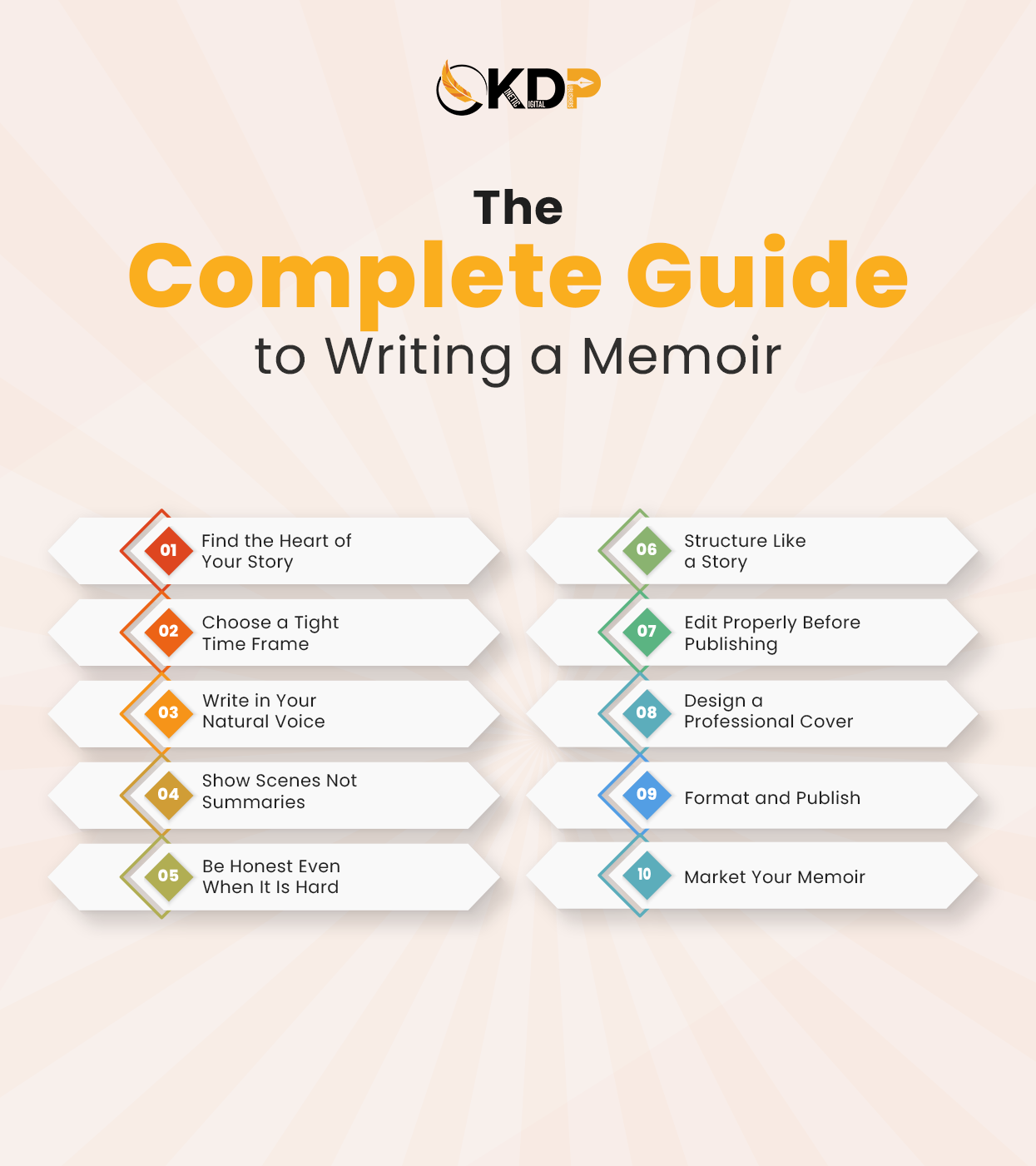
Step One: Find the Heart of Your Story
Before you write a single word, ask yourself one question. What is this memoir really about?
Not what happened but what it meant. What did you learn? What changed inside you? What do you want readers to feel or understand when they finish the last page?
Your answer to that question is the heart of your memoir. Everything else — the scenes, the conversations, the timeline should point back to that core truth. When your memoir has a clear heart, readers feel it from page one.
Step Two: Choose Your Time Frame
One of the biggest tips to help you write a strong memoir is this do not try to cover too much ground.
Pick a specific window of time. Maybe it is one year. Maybe it is five years. Maybe it is a single summer that changed the direction of your entire life. Whatever it is, stay inside that window.
When writers try to cover decades all at once, the story loses its depth. The more tightly you focus your timeline, the more room you have to go deep into the details that make a story feel real and alive.
Step Three: Write Like You Are Talking to a Friend
This is the tip that changes everything for most first-time memoir writers. Stop trying to write like a writer. Just talk.
Imagine your closest friend sitting across from you, and you are telling them what happened. You would not use fancy words. You would not write long complicated sentences. You would just talk.
That natural voice the one you use when you are being real with someone you trust is exactly the voice your memoir needs. Readers can feel the difference between someone performing and someone actually sharing. Share. Always share.
Step Four: Show the Scenes, Do Not Just Summarize Them
There is a big difference between telling someone what happened and taking them there.
Telling: “That year was really hard for my family.”
Showing: “I remember standing in the kitchen at 11pm, eating cereal for dinner because that was all we had left, listening to my parents argue quietly in the next room.”
The second version puts the reader inside the moment. They can see it. They can feel it. That is what great memoir writing does it recreates the experience so fully that the reader lives it alongside you.
Every time you catch yourself summarizing, stop and ask can I write this as a scene instead?
Step Five: Be Honest Even When It Is Uncomfortable
Honesty is the engine of every great memoir. Not brutality, not oversharing, but real honest truth about what you felt, what you did, and what you wish you had done differently.
This means writing about your own mistakes, not just the wrongs done to you. It means showing your fear, your confusion, your shame not just your strength. It means letting the reader see the full picture, not just the version that makes you look good.
Readers trust writers who are willing to be vulnerable. And that trust is what turns a good memoir into an unforgettable one.
Step Six: Structure Your Memoir Like a Story
Even though your memoir is true, it still needs to move like a story. That means there needs to be a beginning, a middle, and an end and a clear sense of change between all three.
At the beginning, the reader meets who you were before. In the middle, something happens that challenges or shifts you. By the end, you are different from the person on page one. That arc of change is what gives a memoir its emotional shape.
You do not have to tell your story in the order it happened. Some of the best memoirs start in the middle of a dramatic moment and then circle back to explain how it all began. Play with the structure. Find the order that creates the most impact.
Step Seven: Edit Your Memoir Properly
Once your first draft is done, take a deep breath. Then get ready to edit.
Most writers underestimate how important editing really is. Your first draft is just the raw clay. Editing is where the actual shape comes from. You will cut scenes that slow the story down. You will strengthen sentences that feel weak. You will sharpen the moments that matter most.
It helps to leave your draft alone for a week or two before editing. Distance gives you fresh eyes. You will catch things you missed completely when you were deep inside the writing.
After you do your own edits, bring in a professional. Expert book editing services can see what you cannot see from inside your own story. An editor does not change your voice — they help it come through more clearly.
Step Eight: Design a Cover That Does Your Story Justice
People judge books by their covers. That is just true. A great memoir with a poor cover will be ignored. A great memoir with a striking, well-designed cover gets picked up, opened, and bought.
Your cover needs to communicate the tone and feeling of your story at a glance. A memoir about grief should feel different from a memoir about triumph. A memoir about adventure should look different from one about quiet healing.
Working with someone who understands custom book cover design ensures your cover reflects the emotional weight of your story and connects instantly with the right readers.
Step Nine: Format Your Book for Publishing
Formatting is the part most authors skip and it shows. A badly formatted book looks unprofessional on the inside, even if the writing is great.
Proper formatting means consistent fonts, clean chapter headings, correct margins, and a layout that is easy on the eyes. For ebooks, it also means making sure everything looks right across different reading devices.
Good formatting is invisible. Readers should never notice it. They should just feel comfortable from the first page to the last.
Step Ten: Choose How You Want to Publish
When your manuscript is edited and formatted, it is time to think about publishing. You have two main paths traditional publishing and self-publishing.
Traditional publishing means submitting to a literary agent, waiting for representation, and then waiting again for a publisher to pick up your book. It can take years and comes with a lot of rejection along the way.
Self-publishing gives you full control. You set your own timeline. You keep your rights. You earn higher royalties per sale. And with professional book publishing services, you can publish at the same quality level as any traditional house without giving up creative control.
Most memoir authors today choose self-publishing because it is faster, more flexible, and puts the author in charge of their own story.
Step Eleven: Market Your Memoir So Readers Can Find It
Writing and publishing your memoir is only half the journey. The other half is getting it in front of readers.
Marketing sounds overwhelming to most first-time authors. But it does not have to be. Start simple. Share your story on social media. Talk about why you wrote it. Give readers a reason to care before they even open the book.
Building an email list of people who are already interested in your story is one of the most powerful things you can do. When launch day comes, those people are ready and waiting to buy and leave reviews.
Using effective book marketing strategies can help your memoir reach readers who would never have found it otherwise people who needed your story and just did not know it yet.
What Makes the Most Engaging Memoirs Stand Out
After everything the writing, the editing, the publishing, the marketing what truly separates a memoir that lingers from one that is forgotten?
It comes down to three things. Honesty, specificity, and emotional truth.
Honesty means telling the real story, not the comfortable version. Specificity means using real details names, places, smells, sounds — instead of vague descriptions. Emotional truth means letting the reader feel what you felt, not just know what happened.
The most engaging memoirs make readers feel seen. They say the quiet parts out loud. They give language to the feelings people carry but cannot name. That is the kind of memoir worth writing. And it is absolutely within your reach.
You Do Not Have to Do This Alone
Writing a memoir is personal. But publishing it does not have to be a one-person job.
From editing to cover design, formatting to marketing, there are people who do this every day and know exactly what works. Getting the right support does not take anything away from your story. It gives your story the best possible chance of reaching the readers who need it.
If you are ready to take that next step, drop us a line and let the team at Kinetic Digital Publishers services help you turn your story into a finished, published, and marketed memoir that stands the test of time.
Conclusion
Every great memoir started as a blank page and a person brave enough to begin. Now that person is you. When you write a memoir, you are doing something that matters. You are preserving a piece of truth that only you can tell. You are offering readers a story that might change how they see their own lives.
Take the first step today. Sit down. Start writing. Do not wait until the words feel perfect they never do at first. Just begin.
And whenever you are ready for help with editing, publishing, cover design, or getting your memoir into the hands of readers, Kinetic Digital Publishers services is here to walk the whole journey with you.