|
Getting your Trinity Audio player ready...
|
The Complete Guide to Writing a Memoir
In each individual, there is an experience that nobody else shares. Not because the experience is remarkable, like something in a movie, but because it was unique to them. The experiences that made them cry, the people that made them who they are today, the struggles that almost ended their journey, yet they managed to survive, they are all important, worth being shared.
Writing a memoir requires a lot of courage. It is about sharing your true self with someone who knows nothing about you and trusting that this experience will be valuable to them. And more often than not, it turns out to be just that. Writing your life story is about sharing the most vulnerable part of yourself.
However, most individuals who have decided to turn their experiences into a memoir never get to start their writing. They believe that their story is not worth telling, their writing skills are insufficient, or that they simply cannot find their way to writing their story down. This guide aims to address that issue by taking the reader through the whole process of turning a story into a published memoir in easy-to-understand terms.
No technicalities, no theory. Only facts.
What Is a Memoir — And How Is It Different From an Autobiography
First things first, let us resolve the misconception that prevents most people from taking the step to start.
While an autobiography is your entire story, your life from birth till the present day, your biography, relationships, career, achievements, etc., a memoir is quite the opposite. While an autobiography is the broad picture, a memoir narrows its focus to one particular episode or period, relationship, and event that played a huge role in shaping your life and experience.
Imagine that an autobiography is an extensive photo album, filled with memories captured during each and every year of your life. In comparison, a memoir would be that one photo, which was enlarged to such dimensions that one could see all the details and emotions expressed by your facial expression and other characters in the picture.
That is how the difference lies between memoir and autobiography. However, do not consider it a disadvantage in any way.
Why Your Story Deserves to Be Told
And this is the doubt that silently destroys more memoirs than poor writing can ever hope to kill. “Who would want to read about me?” This is a legitimate question. And the answer will shock you.
People don’t buy memoirs to read about famous personalities. They buy them because they feel a sense of familiarity. They are tired of being lonely. They crave validation that there was somebody out there who went through the same hell that they have gone through and survived.
You do not have to have a dramatic story in order for your memoir to succeed. You just have to be honest about your experiences. People are touched by books which recount divorce, complex relations with parents, loss and rediscovery of faith, second chances after the age of fifty, things which celebrity memoirs usually gloss over in their search for fame.
The most engaging memoirs are not written by the most famous people. They are written by the most honest ones. That is a playing field where anyone can compete.
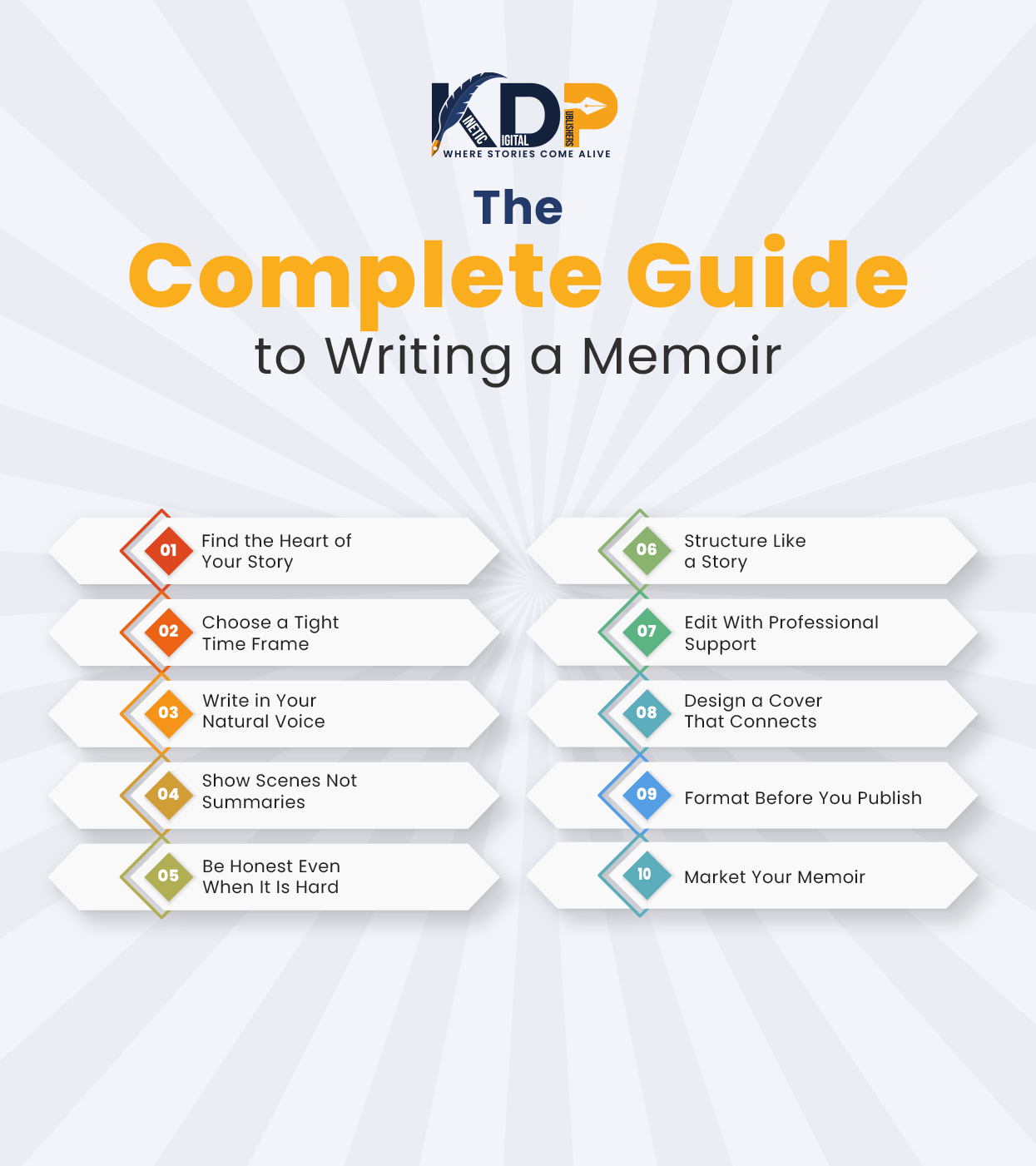
Step One — Find the Heart of Your Story
Even before putting pen to paper, take a seat and pose one question to yourself. What is the message in this memoir?
It is not about what has happened, but about what has been changed and learned because of these events. What lesson does the author want to leave readers with when they finish reading the last page of the memoir? The response to this question will be the core of any memoir. This is its main purpose, around which all other elements must revolve.
The lack of focus on the memoir’s key idea often results in writing a meaningless story, no matter how beautiful some parts of it may be. Therefore, this is an essential step for any writer.
Step Two — Choose a Focused Time Frame
A key piece of advice for writing an excellent memoir is to avoid doing too much all at once.
Choose a particular timeframe and stick to it. This could be one year, a whole summer, or a period of five years that completely altered the course of your life. Regardless of which timeframe you choose, stick with it without letting your narrative stray from its boundaries.
Whenever an author tries to cover a lifetime in one go, they lose depth. Simply put, there will never be enough space to do justice to any particular event in their lives. The more focused your timeframe, the more you can go into the depth of your story by focusing on minute details rather than giving summaries.
This is the way you get to understand the emotional journey in your narrative.
Step Three — Write Like You Are Talking to Someone You Trust
There is only one key piece of advice that will help a beginner at writing memoirs. Stop writing like a writer. Just speak.
Think about the most trusted of all your friends right in front of you, as you relate to her or him what happened. You will not be employing fancy vocabulary. You will not be composing long sentences in an attempt to astound your reader. You will simply say what you have to say in the simplest way possible.
The simple and genuine speaking tone is precisely what your memoir requires. Readers understand when someone pretends and when someone reveals their true self. It may come out either way in the reading, but the pretending tone will make the work feel detached from reality. And that will not help you get your message across.
Speak the way you do and then edit it to perfection.
Step Four — Show the Scenes, Do Not Just Summarize Them
A huge difference lies in simply explaining to the reader what transpired and actually transporting them right into the situation. That’s the difference between writing a mediocre memoir and penning down the most memorable memoirs the reader will ever have read.
Tell: “That winter was one of the hardest winters I’ve endured.”
Show: “That winter, I often sat in my car in the driveway for a good twenty minutes whenever I got back home after work, because I wasn’t quite ready to get back inside yet. I used to do that all that winter.”
The latter example doesn’t even really explain why the winter was hard; it shows how hard it was. The reader feels it without having it explained to them. They know what kind of winter it was to the very core, even if you don’t explicitly say so.
The moment you find yourself summarizing events, ask yourself if you could instead create a scene and transport the reader right into that experience. Chances are that out of ten times, you probably will be able to.
Step Five — Be Honest Even When It Is Uncomfortable
It is important to emphasize that honesty is not an additional trait of memoir writing. Honesty is the key factor that drives the entire process.
In order to show honesty, one needs to demonstrate not only the flaws of other people but their own mistakes and failures as well. One should not hesitate to mention fear, anxiety, or lack of understanding of the situation as long as these emotions were experienced by the author at that time. At the same time, it is necessary to avoid self-aggrandizement in order to let readers know the truth about the author.
The ability to be honest may be challenging for many memoirists since people usually try to conceal their flaws from others during conversations. In addition, it is important to note that honest memoirs are more memorable due to the willingness of the author to disclose personal information.
At the same time, the most difficult part of writing memoirs becomes the best part for readers.
Step Six — Give Your Memoir a Story Structure
Even if your memoir is entirely factual, it must still have some semblance of storytelling. This includes having an introduction, body, and conclusion with a definite feeling of progression through each.
The first part shows the reader who you were at the start of the tale. In the middle section, an event occurs that causes you to shift or change drastically in some way. The result? You become someone completely different from who you were at the beginning. This is how you create a compelling arc that keeps people interested in your personal narrative.
You don’t need to tell your story chronologically. Sometimes, it works much better to begin the memoir in the middle and unravel your story from there. Other times, you may find a unique pattern works best. Experiment with the order and see which approach makes your memoir most emotionally impactful.
Step Seven — The Book Editing Process Is Not Optional
With your first draft now complete, let out a sigh. You have accomplished something truly challenging. However, what comes next is what turns your raw draft into a book.
Editing the book is the stage at which the final form of your memoir takes shape. Your first draft is like clay. Editing involves sculpting it to perfection by deleting scenes that may make your memoir drag, fixing weaker sentences, and polishing emotionally charged moments.
It might prove useful for you to step back from your manuscript for at least a week or two prior to embarking upon editing it. This will allow you to gain a fresh perspective that you simply will not have access to if you dive headfirst into editing immediately. The things that will become apparent to you — redundancies, flawed logic, overly protracted scenes — would remain unnoticed until this point.
Finally, after you edit the book yourself, hand it to a professional editor. Book editing services offered by an expert will help you discover elements of your story that you were unable to become aware of. Such an editor will make no attempt to alter your voice; rather, it will make it shine through.
Step Eight — Design a Cover That Reflects Your Story
Judgments are made in seconds, and most of it occurs even before opening the book. The cover of your book is making these decisions for you before the reader has the chance to read your writing.
An amazing memoir with a terrible cover is ignored, but a good cover catches the reader’s attention and draws them in. This may seem shallow, but it’s simply the way that people read.
Your book cover needs to convey the mood and emotion behind your story immediately. A book about death and loss will need a different cover than a story about surviving something. A memoir that takes place in a particular time period can incorporate visuals associated with that period. A story about addiction and recovery has a completely different mood than a travel memoir or family story.
Getting help from someone with expertise in book covers helps ensure that you get the best first impression possible for your book.
Step Nine — Format Your Memoir Properly Before Publishing
It is the element that most new authors neglect, and it is always easy to see when an author does that. When an author fails to format a book correctly, the book will look amateurish, no matter how well-written it might be. The reader might not know what formatting is, but they will definitely know something is off.
Proper formatting consists of choosing a clear font, making clean chapter headers, maintaining proper margins, and arranging content in a way that will not tire out the reader’s eyes. For eBooks, it consists of doing this while also making sure that it will render correctly regardless of the reader’s device, from Kindle to iPad to smartphone.
Format properly so that your reader will never have to think about it.
Step Ten — Choose Your Publishing Path
Once the editing of your manuscript and formatting of your book are complete, it is time to think about how you wish to publish your book. There are essentially two options, each of which comes with distinct pros and cons.
The traditional route involves sending out queries, seeking an agent, and potentially waiting years until your book finds its way into a publisher’s hands. It entails dealing with numerous rejections, giving up creative control, and receiving royalties at much smaller percentages compared to those available through self-publishing.
With self-publishing, you have full control over your book’s creative vision and financial decisions. This means you get to design your cover art, determine the pricing, and retain all your rights as an author. With the help of professional book publishing services, you can publish a book as high-quality as the ones produced by any major publishing house, while still retaining the freedom that matters most to you.
These days, most memoir writers are opting for self-publishing because it saves them valuable time and enables them to make decisions themselves rather than handing their book over to someone else to publish.
Step Eleven — Market Your Memoir So the Right Readers Can Find It
Your job as an author ends with writing your memoir and seeing it published; after that, it’s all about marketing it. And that is where most writers fail – by underestimating how much work and attention it takes to market a memoir effectively.
Don’t let that scare you, though, because there is an easy way to get started with book marketing. All you need to do is be present, talk about yourself and the reason you decided to write a memoir, and give some insight into your experience while working on your book. Tell your story on your blog or any social media platform you choose. That way, people will start to form connections with you as an author long before they ever see your book.
Gathering emails from readers who are genuinely interested in your life and memoir-writing experience can prove to be an extremely powerful marketing strategy for you, and on the launch date of your book, you will be able to turn these people into buyers and reviewers of your memoir.
If you want to reach out to readers beyond your immediate circle, consider using ads and reaching out to different blogs and podcasts that may interest your audience.
What Separates the Most Engaging Memoirs From the Ones That Are Forgotten
Despite all the writing, revising, editing, publishing, and promotion, how does a memoir stick in a reader’s head long after they finish it, while another memoir fades into oblivion?
It all comes down to three elements each and every time. Those three elements are honesty, specificity, and emotional truth.
Honesty refers to telling the whole story without sugar-coating anything, without changing any of the facts, or altering your character’s image. Specificity entails incorporating actual details into your narrative rather than generalities. Emotional truth refers to allowing readers to experience the same emotions that you had during the events in question. The most intriguing memoirs help their audience see themselves in the writer’s shoes. It speaks of the things that people think but never say out loud.
Such a memoir will garner rave reviews and be recommended by friends and relatives for decades to come. Such a memoir is totally achievable for you as well.
You Do Not Have to Figure This Out Alone
Creating a memoir is a very personal process. However, writing it down on paper does not mean that it should become a reality all by yourself.
Whether it comes to editing and designing a cover or formatting a book, publishing, and book marketing, there are professionals who can handle it for you and understand all the requirements to make your memoir successful. Seeking proper assistance does not ruin your story. Instead, it provides your story with a proper venue to shine.
If you are ready to move forward, either to create one from scratch or publish a draft lying in a drawer somewhere, contact us at Kinetic Digital Publishers, and we will help you create, publish, and promote your story.
Conclusion
Every great memoir starts the same way — a blank page and a person who decided their story was worth telling. Now that person is you.
Writing a memoir is not just a creative exercise. It is an act of courage and generosity. You are preserving something true that only you can offer. You are giving readers a story that might change how they see their own lives, their own struggles, their own capacity to survive and grow. That is not a small thing. That is a genuinely meaningful contribution to the world.
The book-writing process is not always easy. There will be drafts that feel wrong, chapters that refuse to come together, and moments where you wonder if any of it is working. Push through those moments. The story on the other side of that resistance is almost always the one worth telling.
Start with one scene. One memory. One moment you have never been able to stop thinking about. Write that. Then write the next one. The full memoir will come together one true piece at a time.
And whenever you are ready for support with editing, cover design, formatting, book publishing, or getting your memoir in front of readers through smart book marketing, Kinetic Digital Publishers is here to walk the whole journey with you. Your story deserves to be finished. It deserves to be published well. And it deserves to reach the readers who need it most.
FAQs
Q1. How do I start writing a memoir if I have never written a book before?
Start by identifying the core experience or time period your memoir will focus on. Then write freely without worrying about quality, get the story down first, and shape it later. Most first-time authors find it easiest to begin with specific scenes they can picture clearly, rather than trying to tell everything at once in chronological order. The book-writing process always starts messy. That is completely normal.
Q2. How long should a memoir be before I think about book publishing?
Most published memoirs land between 60,000 and 90,000 words. Shorter memoirs can work well at around 50,000 words if the story is tightly focused and moves well. Once your draft is complete, professional book publishing support can help you assess whether your manuscript is the right length for your specific story and the audience you are trying to reach.
Q3. Do I really need professional book editing before I publish?
Without question, yes. Even strong writers miss things in their own work — it is simply too difficult to see your own blind spots after you have read something dozens of times. Professional book editing helps with structure, clarity, pacing, and consistency, while making sure your voice comes through as powerfully as possible. Editing is not about changing what you wrote. It is about making what you wrote land the way you intended.
Q4. How important is cover design to a memoir’s success?
More important than most first-time authors expect. Your cover is the first impression your book makes on every potential reader in a bookstore, on Amazon, and on social media. It sets the tone, signals the genre, and tells someone in a single glance whether this book might be for them. A poorly designed cover can cost you, readers, no matter how powerful the writing inside is.
Q5. Can self-publishing help my memoir reach a wide audience?
Absolutely. Self-publishing today can reach just as wide, and sometimes a wider audience than traditional publishing. With the right book marketing strategy in place, your memoir can find readers across the country and around the world. Many bestselling memoirs were self-published by first-time authors who told their story honestly, produced it professionally, and marketed it with intention.