|
Getting your Trinity Audio player ready...
|
Editing vs Proofreading: What’s the Difference & Why It Matters
You finished writing your book. Congratulations! Now comes the part that confuses most authors: making it ready to publish.
Many writers think editing and proofreading are the same thing. They’re not. Understanding editing vs proofreading could be the difference between a successful book and an embarrassing one.
Skipping either step hurts your book’s success. Readers notice mistakes immediately. Bad reviews pile up. Your credibility suffers. All are preventable with the right approach.
This guide explains both processes clearly. You’ll know exactly what each does and why your book needs both.
What Editing Actually Means
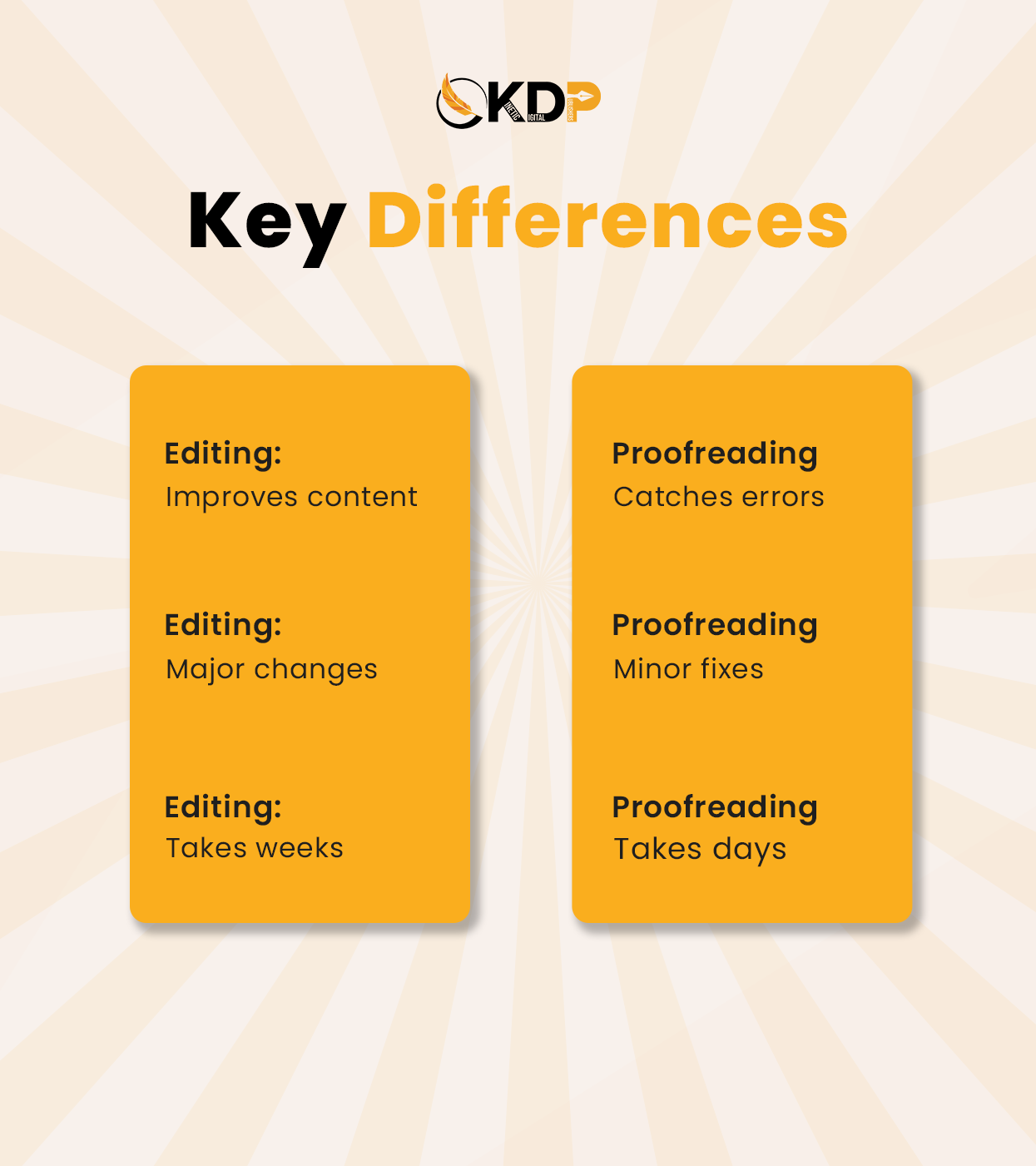
Editing improves your entire manuscript. It’s about making your writing better, clearer, and more powerful. Not just fixing typos improving everything.
Editors look at your story structure. Your arguments. Your pacing. They find plot holes in fiction. Weak reasoning in non-fiction. Parts that bore readers.
Book editing tips always start here: editing comes first, long before proofreading. You can’t proofread what isn’t properly edited yet. Order matters hugely.
Different Types of Editing
Developmental Editing
It fixes big problems. Story structure. Character development. Organization of ideas. This happens first when your manuscript needs major work.
Line Editing
It polishes your sentences. Makes them flow smoothly. Cuts unnecessary words. Strengthens weak phrases. Your voice stays yours but sounds better.
Copy Editing
Copy editing catches grammar, punctuation, and consistency errors. Makes sure names are spelled the same throughout. Fixes verb tenses. Ensures clarity.
What Proofreading Really Does
Proofreading is the final quality check. It catches tiny mistakes that slipped through editing. Typos. Missing words. Extra spaces. Final polish before publishing.
Proofreaders don’t rewrite sentences or restructure paragraphs. That’s editing’s job. Proofreading assumes your writing is already good. It just finds little errors.
Think of proofreading as inspecting a finished house for dust and fingerprints. The house is built. Now you’re cleaning windows and touching up paint.
Why You Can’t Skip Either One
Some authors think “I’ll just proofread myself and save money.” This always shows in the final product. Always. Readers notice.
You can’t see your own mistakes well. Your brain fills in gaps. Skips over errors. You’ve read your manuscript so many times you’re blind to problems.
Manuscript refinement requires both professional editing and proofreading. One without the other leaves your book half-finished. Readers deserve your best work.
Difference Between Editing and Proofreading
The Cost of Skipping Editing
Books without proper editing get destroyed in reviews. “Boring middle section.” “Confusing plot.” “Rambling chapters.” These problems come from lack of editing.
Poor structure kills sales. Readers quit halfway through. They don’t recommend your book. They might not buy your next one. First impressions matter permanently.
Even well-written books need editing. Every bestselling author works with editors. It’s not a sign of weakness. It’s professional standard practice.
The Cost of Skipping Proofreading
Typos look unprofessional. “Your” instead of “you’re.” “Their” instead of “there.” Readers notice immediately. Credibility dies with obvious mistakes.
Reviews mention errors constantly. “So many typos!” “Needed proofreading!” One-star reviews for preventable mistakes. Your book’s reputation damaged forever.
Fixing mistakes after publishing is possible but embarrassing. Readers who bought the error-filled version already formed negative opinions. Prevention beats correction.
How Editing Improves Your Book
Editors make your good writing great. They see what you can’t. Fresh eyes catch problems you’ve stared past a hundred times.
Plot holes get fixed. In fiction, editors find inconsistencies. Characters who disappear. Timelines that don’t work. Problems readers would notice and hate.
In non-fiction, editors strengthen arguments. Find weak logic. Suggest better examples. Make complex ideas clearer. Your message lands stronger.
How Proofreading Protects Your Reputation
Clean error-free books look professional. Readers assume you’re serious about your craft. They trust your content because presentation shows quality.
Proofreading catches embarrassing mistakes. The ones that make readers stop and laugh. Not in a good way. The ones that get screenshot and mocked online.
Professional authors publish clean books. Amateurs publish messy ones. Proofreading is the difference. Readers see it even if they don’t consciously know why.
Common Editing and Proofreading Mistakes
Doing them in wrong order wastes money and time. Proofread before editing means paying for proofreading twice. Edit first always.
Thinking spell-check is enough. Computer spell-check misses tons of errors. It doesn’t catch wrong words spelled correctly. “There” vs “their” looks fine to spell-check.
Asking friends and family to edit. Unless they’re professional editors, they’ll miss things. They’re too nice to tell you your baby is ugly. You need honest professional feedback.
What to Expect from Professional Editors
Timeline: Developmental editing takes weeks. Line editing takes less time. Proofreading can happen in days. Plan accordingly for your publishing schedule.
Communication: Good editors explain their suggestions. They don’t just change things. They help you understand why. You learn and improve as a writer.
Results: Professionally edited books sell better. Get better reviews. Build your reputation as a serious author. The investment pays for itself many times over.
Getting Both Services Done Right
Many publishers offer both editing and proofreading. Working with one company for both ensures consistency. Your editor and proofreader communicate. Nothing falls through cracks.
Professional book publishing support includes both services. One team handles everything. Smoother process. Better results. Less stress for you.
Complete self publishing services cover editing, proofreading, design, and distribution. You get quality at every step. Your book competes with traditionally published ones.
Conclusion
Understanding editing vs proofreading helps you publish books that succeed. Both serve different crucial purposes. Both are absolutely necessary.
Book editing tips start with getting professional help. Don’t skip either service to save money. The cost of poor quality is much higher than the price of editing.
Manuscript refinement through proper editing and proofreading separates amateur books from professional ones. Readers notice quality immediately. Give them your absolute best.
Ready to transform your manuscript into a polished professional book? Get expert editing support from Kinetic Digital Publishers’ professional editing services. We handle both editing and proofreading. Your book deserves nothing less than excellence.