
|
Getting your Trinity Audio player ready...
|
How to Design a Book Cover That Actually Sells Books
You might spend years crafting your book. Put your soul into each chapter. Redraft the ending several times. And then slap a bad cover onto it and let it sit there and do nothing. This is the brutal truth that many writers learn the hard way.
The decision about whether or not to download your book is made by the reader in a few seconds, perhaps even less than that. Within those few seconds, the cover does all the work for you. It tells the reader whether this is a book he or she wants to read.
That’s why learning how to design a book cover properly is one of the most important things you can do as an author. This guide will help you understand what makes a cover effective, what kills a cover, and how to ensure that your book appears worthy of being a best-seller.
Why Your Book Cover Is Your Most Important Marketing Tool
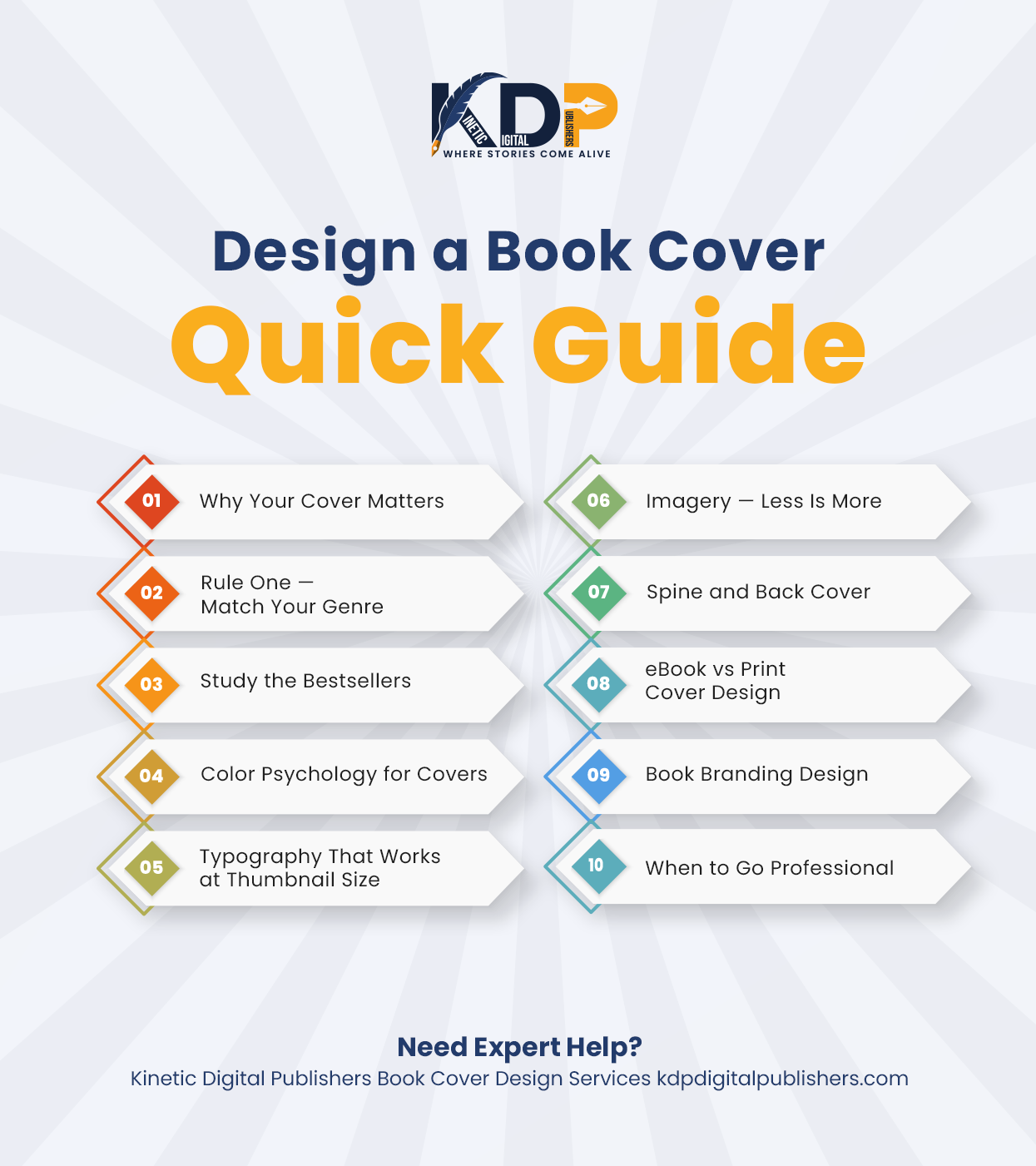
Most writers tend to see marketing as advertising, social media engagement, and e-mail lists. Indeed, that is true and very important. However, your book cover works as a marketing tool whenever your book is alive and published – on Amazon, on Goodreads, in search engine results, in e-mail recommendations, and even on book blog sites.
When anyone sees your book, the first thing they will see is your book cover. Before seeing the book title or reading the plot, before seeing any reviews on the book, that is how they are made to form their initial impression. And, it could happen whether or not it was intended by you.
An excellent cover attracts people while a bad cover drives them away without their knowing why. This is why investing in professional book cover design is never a waste of money. It’s the investment that pays for itself every single day your book is on sale.
The First Rule — Your Cover Must Fit Your Genre
This is the single most important rule when you design a book cover. It is one mistake that many new authors tend to make. While having an appealing cover, you also have to create a cover that fits in well with the category you chose to write about. Different genres have different ways of communicating visually. For example, thrillers should have a cover with dark colors and fonts and an image that conveys tension. In romance novels, depending on whether it’s a sweet or steamy romance, different colors, fonts, and illustrations may be required.
If you choose the right type of font and illustration, the reader will know that it’s a book that is worth buying because it belongs to his/her favorite category. But when there’s some disconnect between the actual genre and what you’re showing, it’s not clear whether he/she should open that book or not.
Study the Bestsellers in Your Category
Before you begin designing anything, spend thirty minutes on Amazon. Go to the category that your book belongs to. Examine the top twenty best-selling books’ cover designs. Pay close attention.
What colors dominate? What font styles can you see? What kind of visuals are used – illustrated or photographs? Are they minimalist or elaborate? How large is the title? How large is the author’s name? What common elements do all these cover designs have?
Copying cover designs does not work. You don’t need to copy anything here. These best-selling covers were designed for a reason. They work because they communicate with their target audience using the language that they know and understand well. This is what you need to do as well.
Color Psychology — How Colors Make Readers Feel
Among the elements in cover design, color is one of the most potent but, unfortunately, not utilized as much as it should be by most authors. This is because colors have an impact on the emotional state of the viewer before he even reads your title. Darker shades of blue and black evoke a mysterious aura that will do well in thriller and horror novels. Red and golden colors are associated with passion and excitement and would be suitable for romance or adventure stories.
Soft pinks and lavender have a tender and emotive effect and can be found in women’s fiction and romantic literature. White and gray colors are modern and trustworthy, and make ideal choices for self-help and business publications. These are just suggestions, and while they cannot be broken, there is a basis for choosing the colors of your cover based on real-world experience.
Typography — Your Title Needs to Be Read in a Thumbnail
Here’s something that the designers know about their designs, which most of the authors are unaware of — the cover has to look good as a thumbnail image, too. After all, the reader will likely encounter your book in the form of a postage stamp-sized thumbnail image, and if he won’t be able to read your title there, you’ve just lost him.
Use fonts that are easy to read and relatively bold so that even at this small scale, your title will look nice. Avoid using decorative script fonts that might look wonderful in a bigger image format, but which will become illegible when scaled down into a small thumbnail.
The cover has to make sure that the title stands out more prominently than everything else, including your name, which can be smaller and less prominent for new authors.
Imagery — What to Show and What to Leave Out
Before a word is written, the image on your cover establishes its emotional mood. It needs to set an immediate atmosphere for the reader. Yet, while too little information can be misleading, having too much on a book cover can also be confusing.
If you are writing a fictional work, having one distinct image is often preferable to including too many characters or objects within the scene. If your book covers non-fictional topics, having a clear idea is often easier to convey than a literal illustration.
Regardless of what you decide to use, your image must reflect the emotional essence of your book and not just because it was cool at the time of design.
The Part Most Authors Overlook — The Spine and Back Cover
If you are going to create a paperback version, you still have a few more design aspects to consider after you’ve made the front cover perfect. These include the spine and the back cover, which can really make a difference for readers who found your book by chance on physical shelves or on someone else’s shelf.
The spine should have your title and your name as an author in bold text and a legible font. The back cover should contain a brief description of your book, an author photo if you have one, the barcode, and a biography. They all need to be neatly designed to fit into the exact parameters that Amazon requires from all printers.
Failing to meet these requirements is going to get your book rejected when trying to upload it to Amazon, and then you’ll have to redesign everything from scratch.
Here’s What Most Authors Get Wrong About DIY Design
Many novice writers prefer designing their own book cover using freely available tools online. Most of them come up with designs that look pretty good to their eyes. The problem is that they designed the cover themselves. They understand the meaning behind the cover art. They see their story within it.
The sad reality is that an average reader will not be familiar with the writer’s story before purchasing the book. All he sees is the cover, which might give away more than meets the eye. When readers take one glance at the self-designed book cover, they can tell that some effort went into creating it, but the person lacked skills in the field. Unprofessional fonts, inconsistent colors, uninteresting imagery, and poorly planned layouts – the flaws are subtle yet noticeable.
Luckily, book cover design services from Kinetic Digital Publishers cater to exactly such problems. You receive a professionally trained designer who will create book cover art based on your preferences and the target audience’s interests. What’s more, all books that our company releases are designed and published by the same publisher. So, when readers see the cover art of your book, they assume that professionals created it.
Amazon Book Cover Design — Getting the Technical Side Right
Of course, designing a beautiful cover is only part of the task. The other aspect to take into consideration when preparing your cover is the need for it to meet certain technical criteria, depending on the platform where it will be sold, especially Amazon.
For Amazon book cover design, your ebook cover must have a minimum width of 2560 pixels, maintaining a proportion of 1.6:1 between height and width. The resolution of the cover for printing should be 300 DPI. The file format should be proper, and that is why the cover should be saved in the right format – JPG/TIFF (print), JPG (ebook). Also, your color profile must match Amazon’s specifications, as the colors will not appear correctly without this.
In case any of the above criteria are not met, your cover will be rejected or printed with skewed colors. All of this is handled effortlessly by a professional designer.
eBook Cover Design vs Print Cover Design — They’re Not the Same
Many writers are surprised to find that this is true. The same file cannot be used for an eBook and for a printed book because of differences in size specifications, colors, and even technical capabilities.
eBook cover design uses RGB color mode because digital screens display color that way. The color mode used in print covers is CMYK because it is used for the printing process. The design may appear differently depending on the color mode used.
The spine and the back cover must be included in your print cover, meaning the size of the file will depend on the number of pages you have. In other words, the wider the file, the more pages you have. However, in an eBook cover, you only need the front cover of your book.
Cover Design for Authors — What to Expect From a Professional
If you’ve never worked with a cover design for authors‘ service before, you may not know what goes into the process. Here is a simplified outline of what a great experience will entail.
First, you provide details regarding your book, such as the genre and the tone of the cover you would prefer. In addition, you also get to provide a description of the story or message. If there are any existing visuals that you would like on the cover, you provide these too. You will also get to provide covers that you admire or don’t.
Once the designer creates designs according to the brief, you evaluate them and provide constructive feedback. This process continues until you achieve perfection. Finally, the design files are provided in all required formats.
Book Branding Design Thinking Beyond One Cover
If you’re planning to write more than one book, and most authors do, it’s worth thinking about your cover design as part of a larger book branding design strategy. People who have enjoyed your first novel must instantly know that the next two novels are penned by you.
This will mean having consistent design features throughout the covers of your novels, which include having the same typeface, using the same colors, and having the same theme and style that create your personal brand as an author. When people see your next novel among other recommended reads and think, “Oh, I remember that author!” – then you’ve got your branding right.
It will be much easier to develop your visual identity from the first novel you write rather than trying to incorporate one at some point down the road.
How Much Does Book Cover Design Actually Cost?
Book cover price is one of the most common questions authors ask, and the range can be extremely wide. From the bottom, there are freelance designers who will offer you book cover designs for less than one hundred dollars on marketplaces such as Fiverr. The more expensive side features specialized book cover designers whose expertise includes designing book covers that sell, with a focus on your specific genre, for hundreds to thousands of dollars.
What you pay for is their expertise in terms of genre-specific design, as well as experience and confidence. A designer who has created numerous book covers successfully for a particular genre already understands things that graphic designers don’t, including visual expectations from the target readership, design flaws that kill sales without readers knowing why, and what makes a professional-looking book cover design.
Your investment decision should be made based on your objectives and resources. However, regardless of the amount you invest in a book cover design, remember that your cover will continue selling your book every single day it is available.
FAQs
How do I design a book cover that works well on Amazon?
Focus on readability at thumbnail size, genre-appropriate imagery and colors, and meeting Amazon’s technical specifications for file size and resolution. Working with a professional who specializes in Amazon book cover design ensures all of these elements are handled correctly.
What’s the difference between eBook cover design and print cover design?
The eBook cover uses only the front cover, while the print cover uses both the front cover and the spine. The eBook cover uses RGB color mode, while the print cover uses CMYK color mode.
How much does professional book cover design cost for a self-published author?
Book cover price varies depending on the designer’s experience and what’s included. The price range for basic covers starts at one hundred dollars, whereas specific genre designers may ask hundreds of dollars. The professional design of a cover is the best investment that an author can ever make in their book.
Can I design my own book cover, or should I hire someone?
However, you are free to do so; however, in most cases, it is easy to tell when a cover was made by someone other than a professional designer. If your budget permits, If your budget allows, professional book cover design services will almost always produce better results and stronger sales.
How can Kinetic Digital Publishers book cover design services help my book?
Kinetic Digital Publishers’ book cover designs provide custom-made covers that are specific to your genre and are created for both e-book and hardcover formats. Our goal is to produce covers that entice potential readers and help convert them from browsers to buyers. Contact us today!
Conclusion
Your book’s cover is never just decoration. It’s a sales tool. A first impression. A promise to the reader about what’s waiting inside. When you design a book cover that truly works, you are not only creating an attractive piece of art but also eliminating the most significant hurdle to getting your book into the hands of its ideal audience.
Every single day your book remains active without a good cover is another day when you miss out on potential sales opportunities. But every single day your book remains active with a good, professional cover is another day when it works hard for you without needing any effort from your end.
Experience Kinetic Digital Publishers’ book cover design services right now.