|
Getting your Trinity Audio player ready...
|
The Shocking Reason Most Self-Published Books Never Sell
Here is a number that most people in the publishing world do not talk about loudly: the majority of self published books never sell more than a hundred copies. In fact, many sell less than ten. Others sell none, not due to poor writing, not due to a poor concept, but due to just a few very specific and very correctable mistakes that almost every author inadvertently makes.
If you’ve got a book on Amazon right now, and sales aren’t happening, or if you’re about to go live and you want to understand what’s really making some books earn while others sink – you are ready for an honest discussion.
This discussion is not about sugar-coating anything. It’s about seeing reality clearly, but more importantly, what you can do about it.
The Real Reason Self-Published Books Never Sell — It Is Not What You Think
The typical writer thinks his/her book is not selling simply because not enough effort has been put into promotion. So he/she promotes more on social media. He/she tells more people about it. Emails are sent. The result remains the same – no sales.
And that’s exactly the problem. Efforts directed toward promoting a book without addressing its weak spots don’t lead to improvement. In fact, they only increase the number of visitors to your page who won’t make a purchase – something which will be noted by the Amazon algorithm, and consequently affect the visibility of your book in future searches.
The problem, in almost every case of self published books failing, is not the promotion. It is the listing itself.
What a Broken Listing Actually Looks Like
A broken listing is clearly not a disaster at first glance. There is nothing that appears to be a problem; it looks just fine, like a book — it has a cover, a title, a description, a price tag. But there’s something about one or all of these things that is quietly dissuading potential customers from buying the product without them even clicking on “Buy Now.”
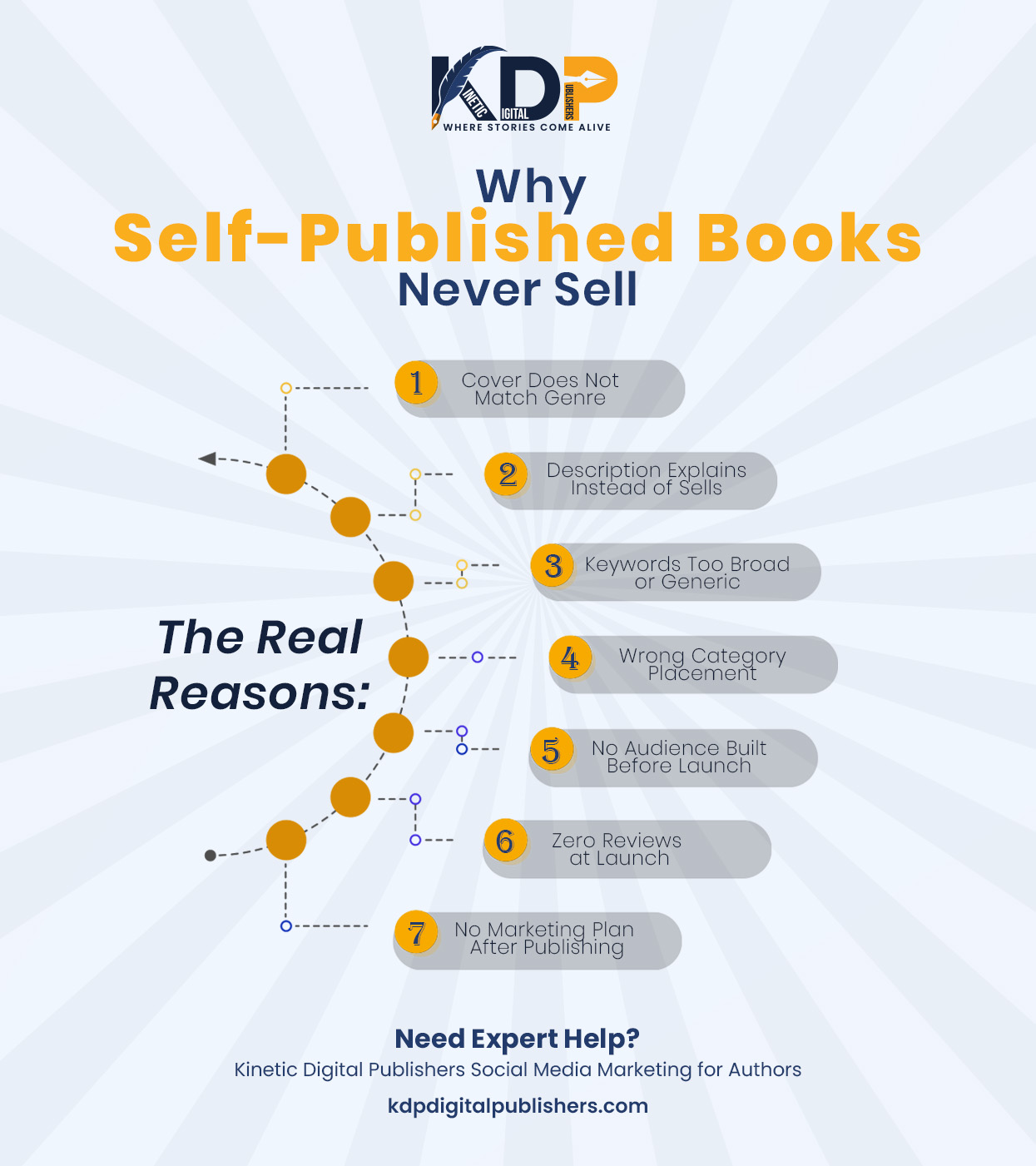
Maybe it doesn’t have the cover that matches what the audience will expect in its genre. Maybe its description doesn’t sell the book, but rather simply tells you what the book contains. Maybe its keywords aren’t specific enough to bring in traffic. Or maybe it’s placed in a category where it’s up against other books it can’t possibly compete with.
Self Publishing Mistake One — A Cover That Does Not Belong in Its Genre
This is the most common reason self published books never sell — and the one which is probably the hardest to hear, since most authors have some sort of connection to their book covers.
The cover of your book does not belong to you; it belongs to the person who will be reading your book. That person will be deciding whether or not to click on your book solely based on that book cover thumbnail, about the size of a postage stamp.
What Genre Readers Are Actually Looking For
Each genre has its own visual language. A thriller knows its thriller cover when it sees one. A romance knows its romance cover when it sees one. A business book knows its business book cover when it sees one. These realizations take place unconsciously, based on many years of exposure to and observation of such books.
A book that doesn’t have that same visual language is a red flag that this isn’t the book the prospective reader is looking for, regardless of how perfectly it fits what the person actually wants. It’s just a matter of expectation versus presentation, and it can turn readers off in an instant.
If you aren’t selling your book, try looking at the top twenty best-selling books in the genre on Amazon. Take a hard look at those book covers. Does yours belong? Of course, it isn’t going to be identical, but does it fit? If not, then there’s your first problem.
Self Publishing Mistake Two — The Description That Explains Instead of Sells
The second most common self publishing mistake is a book description that reads like a summary rather than a pitch. Most authors write their description the way they would describe their book to a friend — factually, accurately, helpfully. And that approach loses sales every single day.
The Difference Between a Summary and a Sales Pitch
The book description gives the reader information about its content. The book pitch elicits a reaction from the reader, making him feel curious, excited, and recognized, and creates an irresistible urge to purchase. These two aspects are totally unrelated, but one of them turns browsers into buyers.
The best descriptions begin with an opening line that evokes an emotion in one sentence. In the first place, such descriptions address readers’ personal problems, desires, fears, etc. Only after that comes the explanation of the book’s content. Besides, they finish with something that makes pressing on “Buy Now” the logical and obvious step to take.
Try to read your book description out loud. If it is similar to a summary of the book, then you are losing sales. Changing the description into a pitch by addressing personal issues first can be done easily without investing any money at all.
Self Publishing Mistake Three — Keywords Nobody Is Actually Searching
Amazon kdp sales tips that actually move the needle almost always start with keywords — because keywords are how readers who do not already know your book exists find it. Amazon’s search engine matches reader searches to available books using the keywords you provide. If your keywords do not match what your target readers actually type, your book simply does not appear in their results.
What Good Keywords Look Like vs Bad Ones
Bad keywords are individual words. “Fiction,” “romance,” “business,” and “self-help” are all examples of poor keywords for your books. You should not use these keywords because they are neither bad nor correct. These keywords are too broad and too competitive for you to use to drive traffic or rank for.
Good keywords are keyword phrases. “Enemies to lovers second chance romance small town” describes a keyword phrase used by someone searching for a certain book genre. If your story fits the above description, using such keywords ensures that your books get found by readers interested in the particular story. The specificity of such keywords makes it easier to rank for them, as well as find your books.
Return to the KDP dashboard and analyze the seven keywords you entered. Ensure that none of them are individual keywords or overly general phrases. Instead, use keyword phrases that will make it easier for your readers to locate your books.
Book Marketing Problems That Happen Before the Book Is Even Published
One of the most important book marketing problems in self-publishing is invisible to most authors because it happens before the book goes live — it is the absence of any audience building before launch day.
Why Launch Week Matters More Than Most Authors Know
It seems that the Amazon algorithm is also aware of sales velocity during the first couple of weeks. When the book makes regular sales from the beginning, it sends a message to Amazon that readers like the content, and in return, the platform will display the book more often via searches and recommendations. When a book sells nothing during its first month, getting any kind of momentum afterward becomes exceedingly hard.
The reason why books sold regularly by authors tends to come from authors who had already created something before their book was released, whether that’s an email list, a following on social media, or some other community based on the topic or genre of the book. These groups of people were waiting to buy the book on the release date.
The creation process can actually be relatively easy. Having a few hundred genuinely interested people who will purchase the book from day one is much better than trying to do anything else after the book’s release. It should be done even before the author finishes his or her work on the book.
How to Sell More Books — The Strategy That Actually Works
How to sell more books is a question that has a cleaner answer than most authors expect. It has nothing to do with searching for some magical marketing channel or simply spending money on advertisements. No, you should get your foundations right first, and only then think about increasing visibility on top of that.
Fix the Listing Before You Drive Traffic
There is no use driving traffic to listings that aren’t selling anything. Make sure your cover, blurb, keywords, and categories are all in working order before even thinking about advertising, running promotions, contacting book bloggers, or doing any kind of push through social media.
An appropriate cover for your genre. A blurb that drives action in the opening sentences. Keywords that target your specific audience. Categories that have a shot at helping you rank. All four components, when used in conjunction, will convert visitors to buyers; otherwise, you’ll just end up disappointed with all your marketing efforts.
Build Reviews Early and Intentionally
The reviews make it clear that the doubting readers will become buying customers after reading them. If a book has no reviews, then it is a matter of asking a stranger for money without having any proof of its usefulness. A book that has thirty genuine reviews, even a combination of four and five-star reviews, is a guarantee of trustworthiness.
Contacting the early readers prior to launch, asking for their feedback on your book, and getting the help of your email subscribers and social media followers to create some buzz during the launch week are the most effective methods of generating reviews without breaking the guidelines set by Amazon.
Here Is the Part Nobody Tells You Until It Is Too Late
And here is a point that must be made because most discussions of self-publishing mistakes avoid this subject like the plague: while recognizing your errors is a good thing, trying to solve several problems at once, along with writing another book, is a tall order for anyone.
The good news is that Kinetic Digital Publishers works specifically with authors in this situation — Whether your book is already published and under-performing, or you are yet to publish your book but would like it done right the first time around, the people here will attend to the various issues you’ll need sorted before publishing your book. They deal with aspects of your publishing process that could take you months to sort out yourself. With all these covered for you, there won’t be anything left to chance when it comes to launching and marketing your book.
Self Publishing Success Strategy — What to Do Right Now
If your book is already live and not selling, here is the most practical order of operations for turning that around.
Start With an Outside-Eyes Review of Your Listing
Approach your listing the way another person would. Visit the listing without having in mind how much time and effort you put into creating the book. Is the cover appealing enough for you to learn more? Does the first line of the description create a certain pull for you? Do the comments, if there are any, suggest something that needs fixing?
Most self publishing success strategy conversations start here because the listing is the single point that every reader passes through. This listing that gets clicks and turns them into sales is where everything else stands. And it deserves much more consideration than many other writers give to it.
Update, Test, and Keep Going
After making adjustments such as a different cover, description, or key terms for your book, allow time for the changes to do their job. This is where the information available in the KDP sales dashboard can come in handy, as it provides performance data week after week. Based on the results, continue improving on what works and move on from what doesn’t.
Book publishing services that include ongoing support, give you someone in your corner as you work through these optimizations — instead of having to figure out what to try next entirely on your own.
Conclusion
The reason most self-published books never sell is not a mystery. And it is a pattern; the same easily correctable flaws in thousands of books, working in the background to alienate the audience that would have otherwise fallen in love with the stories, had it not been for the flaws.
Your book requires a proper chance. It requires a cover that makes people click on it. A description that pulls people toward it. A keywording process that draws people looking for it toward it. Reviews that help gain people’s trust in order for them to finally make the sale. All of which needs to be done long before launch day, not three months later.
All of these are problems that can be easily solved. Each of which is worth fixing, considering the potential of earning passive income from an optimally placed book is very much real, starting the moment you solve these problems.
If and when you are ready to get your hands on the kind of help needed in order to optimize a listing and create a launch plan that works, we at Kinetic Digital Publishers are here for you.
FAQs
Q1. Why do most self-published books never sell, even when the writing is good?
Most self-published books sell not because of the writing quality but because of how the book is presented and positioned on Amazon. An unexpectant cover for your book, an overview that just gives information but doesn’t sell, and keywords that don’t connect to the searches your potential readers are doing online; all of these make it impossible for a potentially great book to be seen by those who will enjoy reading it the most.
Q2. What are the most damaging self publishing mistakes for new authors?
The most consistently damaging self publishing mistakes are publishing without professional editing, with a cover that doesn’t utilize genre tropes, a description that describes what the book is about instead of trying to sell the book, keywords that are too generic to bring in qualified visitors, and starting without an audience or reviews planned out. The average poorly-selling book suffers from several problems at once.
Q3. How do Amazon KDP sales tips actually improve a book’s performance?
Amazon kdp sales tips that move the needle are almost always about the listing itself, not promotion spending. These are the actual keyword phrases that the readers search for, the realistic categories in which the book can actually be ranked, the description that makes the readers purchase, and the cover that fits the genre. All these can be easily fixed at no cost but will surely make a difference in just a matter of days from the date of implementation.
Q4. What does a self publishing success strategy actually look like in practice?
A real self publishing success strategy starts before the book goes live. This includes a cover that is specifically tailored for the genre, the writing of a pitch for the book’s description, research on the specific keywords used to reach the targeted readers, and even having an audience or mailing list prior to the release date. During the launch, it would include purposely getting reviews. Post-launch, it would be about performance tracking and improvement.
Q5. Can book publishing services actually help a struggling book start selling?
Yes — particularly when the problem is in the listing itself. Book publishing services that include listing optimization, Cover design changes, description changes, and keyword research could transform an ineffective listing into a successful one capable of converting visitors into customers. Most authors experience significant progress shortly after implementing changes on their active listing, particularly when the initial problem lies in either the cover or description that is silently repelling potential readers.