|
Getting your Trinity Audio player ready...
|
Why Most Self-Published Books Fail (And How to Fix It)
You were the author of the book. You uploaded it to your website. You published it, but nothing happened. Days turned into weeks. Weeks turned into months. But sales never really took off.
If that sounds familiar, you are not alone, and more importantly, you are not the problem. The truth is that most self-published books fail not because the writing was bad, but due to a few simple mistakes that occur prior to, during, and following the publication process. Simple mistakes that can be easily corrected when one understands them.
This handbook provides insight into real problems and solutions on how to avoid them. No matter how long your book has been out in the market, you will learn how to get better outcomes.
The Hard Truth About Why Self Published Books Fail
Before we look into any solutions, it’s important to consider what is really going on when a book fails to sell.
There are literally millions of books on Amazon alone. Potential readers are searching for the books through keywords, browsing by category, examining covers, and descriptions. In an instant, they will either decide to buy or not to buy a particular book. Most self-publishing mistakes are not writing problems. They are presentation and positioning problems.
The Gap Between Publishing and Succeeding
A book being published and a book being successful are two totally separate endeavors. Book publishing consists of uploading content to an online store and pressing a button. A successful book involves delivering the book in front of the correct person, at the correct time, with the correct message – and repeating this process over and over again until it starts snowballing.
The majority of first-time authors concentrate solely on writing and then pressing that button. What they often don’t realize is the fact that it’s not about hard work; it’s about stopping at the right point.
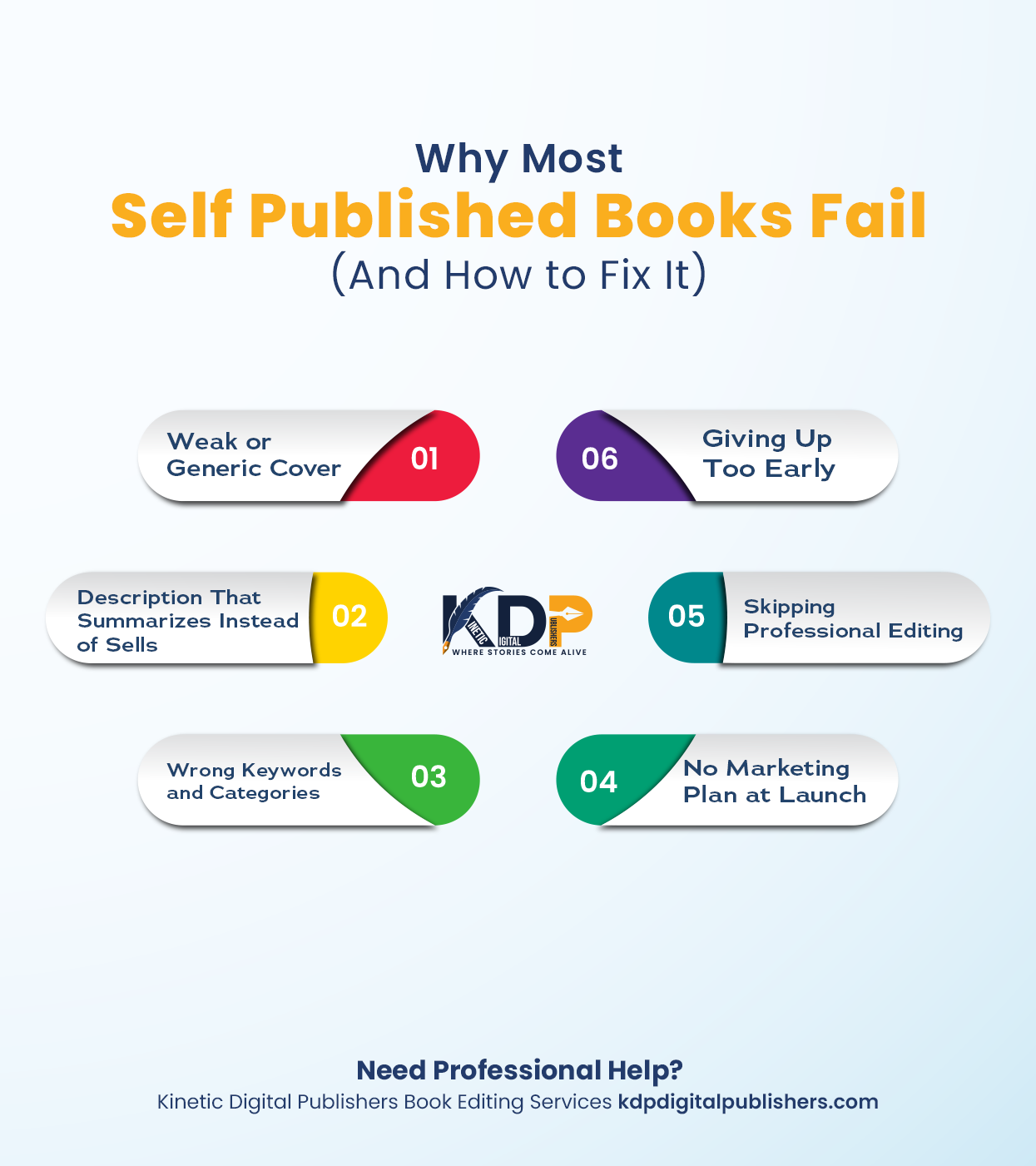
Self Publishing Mistake One — The Cover Is Not Doing Its Job
This is the most common reason books fail, but it is also the thing that most writers dread to hear. Your cover is not merely an image. It is your first sales tool as far as your book goes. It works through Google searches, recommendations, posts on social media sites, and even Amazon pages until someone picks up and opens your book.
If you have a cover that seems boring, old-fashioned, or completely irrelevant to your genre, browsers will keep scrolling down without giving your book another look. It doesn’t matter how good a writer you are if your cover isn’t selling your book. Readers take less than a second to make up their minds, and they’re rarely ever wrong about their gut feelings.
What a Strong Cover Actually Does
The right cover says everything about the genre of the book in seconds. It provides an emotional message that fits the expectations of the reader you’re targeting. The cover design seems like something that should have been there alongside your bestselling competition in the market.
However, the book may have lost its potential customers every single day the cover has been posted online if it has been created too fast, based on a template, or made up from stock images without knowing the genre requirements. This is one of the most fixable publishing errors authors make, and fixing it often produces an immediate, measurable improvement in clicks and conversions.
Self Publishing Mistake Two — The Book Description Is Not Selling Anything
Your description is the second tool a potential reader uses to decide whether to buy. And most first-time authors write descriptions that summarize the book rather than sell it.
A summary tells the reader what happens. A pitch makes the reader feel something curiosity, urgency, recognition and creates enough pull that clicking Buy Now feels like the obvious next move. These are completely different things, and the gap between them shows up directly in your conversion rate.
How to Write a Description That Actually Converts
It is crucial for the first two lines of your product description to have impact. You must make sure that you grab the attention of the potential customer in such a way that he or she wants to continue reading the description. This leads to the next step of making them purchase your product.
When reading your product description, ask yourself whether it sounds like a book report. If it is, then you should change it because it will not fulfill its purpose. This is one of the book sales failure reasons that is entirely within your control to fix today.
Self Publishing Mistake Three — The Wrong Keywords and Categories
Amazon is a search engine for books. Whatever the reader types in the search box on Amazon is what the platform matches with the book through keywords, categories, and metadata. The problem occurs if the searches your intended reader makes cannot match your book because of a lack of relevant keywords. In such a case, even if your cover and description are attractive, no one will see them.
Amazon KDP mistakes around keywords are incredibly common. The keywords used by authors are either too general to compete in or too obscure to find the right audience. “Fiction” is an example of an unhelpful keyword. “A fast-paced crime thriller novel featuring a female detective set in New York City” is the kind of wording that will draw a particular reader who wants that exact book.
Fixing Your Keyword and Category Strategy
Go back into your KDP dashboard and look at the seven keyword slots you filled in. If any of them are single generic words, replace them with specific phrases. Think about what your ideal reader would actually type, not what you would use to describe your book to a colleague, but what someone who wants to read your specific kind of book would search for at midnight on their phone.
For categories, do not just pick the most popular ones. Pick the ones where your book genuinely fits and where the competition gives you a realistic chance of appearing near the top. Placing in a competitive category where your book cannot rank is less useful than owning a more specific category where readers are actively browsing.
Self Publishing Mistake Four: No Marketing Plan Before or After Launch
Here is one of the most damaging book marketing mistakes a new author can make: Marketing the book after the book itself has been launched.
The first week of launch is more important than many authors think. The algorithm at Amazon considers sales velocity. When there is consistent selling during the initial two weeks, the message Amazon gets is that readers are interested in reading the book; consequently, Amazon promotes it further. It becomes almost impossible to build up the sales velocity of a book that fails to make any activity during the first month of publication.
What a Basic Launch Strategy Actually Looks Like
This is not about having a complex marketing strategy.
You need an answer to only one question. Who will discover my book in the first two weeks of its launch, and that too when they don’t know anything about it in the first place?
Will you be creating an email list prior to the launch and then send them the release news? Will you approach certain groups on social media platforms where your target readership hangs out? What about offering a special discount for the first week after launch?
The options are endless, but what’s crucial is that you have some sort of marketing plan in place.
Self Publishing Mistake Five — Skipping Professional Editing
This one is uncomfortable to include because most authors genuinely believe their manuscript is ready before it is. But publishing errors authors make consistently, but the publisher that creates the worst reviews for its books is releasing them prior to proper editing.
In 2026, customers will not forgive that. A book with flaws in structure, with pacing problems, confused passages, and even with errors attracts reviews that comment precisely upon them, and these reviews become visible for all other readers thinking of purchasing that work. Even one review about “many mistakes” or “confused plot” may ruin your sales for quite a long time.
What Professional Editing Actually Changes
A professional editor will never overwrite your voice. An editor protects your voice. They identify the elements you have read so often that they no longer stand out, the sentence where your voice falters, the chapter that lags, the point that needs more traction, and they help you make corrections without compromising your voice in the process.
There is no better investment than editing, and nothing yields better returns in the long run than the work put into editing. This is not something that only applies to well-heeled authors; it is a prerequisite.
Mistake Six: Giving Up Too Soon
How to sell more books is partly a strategy question and partly a patience question. However, most self-published authors who had success didn’t experience immediate success within the first month. Many didn’t experience success even during the first six months.
Gaining an audience is an accumulative process. The first book establishes an initial audience. These people will go on to review and recommend it, thus showing up for the next release. The next book establishes a slightly larger audience. After three or four books, those who persisted would be able to reap the rewards of their efforts.
Those authors who gave up due to lack of success never got to discover the full extent of their capabilities.
Here Is What Most Authors Never Get Told
This is an issue that must be stated because most self-publishing resources will beat around the bush about it: understanding where you have gone wrong in your process can only help you in your book if you have a solution to rectify the mistakes. Simultaneously rectifying errors related to cover design, book description, keywords, marketing tactics, editing, and writing a new book is extremely challenging to execute singlehandedly.
Fortunately, Kinetic Digital Publishers’ self-publishing services are designed to address this issue. If your book is currently on sale but underperforming, or you are planning to publish a book and hope that you can avoid making some common mistakes in the process, we can help. We specialize in all those aspects of publishing that many authors find particularly difficult: cover design, listings optimization, editing, and marketing strategy so that your book can achieve its potential.
An Author Success Strategy That Actually Works
The success of saving a bad book or making a new one successful all depends on taking a holistic approach to the process of publishing rather than viewing it as a one-off activity. Everything must work together. A good cover gets the click. A good blurb makes the sale. Good editing gets the review. Good marketing gets the exposure.
Start With an Honest Audit of Your Current Book
If you already have the book listed but your numbers are not great, take a look at your listing as if you are seeing it for the first time through someone else’s eyes. Look at your listing on Amazon, and as a newcomer to your listing, ask yourself questions such as “Does my cover catch my eye? Does my description encourage me to read on?”
Most self publishing mistakes become visible very quickly when you look at your book from the outside with fresh eyes. The cover that felt fine when you uploaded it might look obviously weak next to the competing titles in your category. The description that seemed complete might read like a summary when you compare it to listings that are actually converting.
Build Your Next Launch Differently
If you are preparing a new book, start your marketing before you finish writing. Build an audience around the topic or genre while the book is still in progress. Talk about it online. Share what you are working on. Get early readers committed to reviewing on launch day.
The author success strategy that produces real results is not a single tactic. It is a series of intentional decisions made consistently across the whole publishing journey from the first chapter to the first year of sales and beyond.
Conclusion
A book that is not selling is not a failed book. It is a book waiting for the right pieces to fall into place. And now you know what most of those pieces are.
The reasons most self published books fail are consistent, predictable, and fixable. A cover that fails to generate the necessary clicks. A summary that describes rather than sells. A set of keywords that are too generic to bring any traffic. A release without the required momentum. An editing process that either got overlooked or was done in haste. None of these is an irreversible mistake. They are simply fixable problems.
Begin with the easiest solution to your current book listing challenge. Solve that first, and then proceed to tackle the other issues. The writers who have managed to transform their underperforming novels into top-sellers are not necessarily the ones who possess the best skills, but the ones who continued to work, improved their approach, and made better decisions each step of the way.
If you seek professional assistance in pinpointing the exact problem with your book and rectifying the issue through informed strategies, look no further than Kinetic Digital Publishers’ self-publishing services.
FAQs
Q1. Why do most self published books fail even when the writing is good?
Most self published books fail not because of the writing quality but because of the presentation around it. A weak cover, a description that does not sell, the wrong keywords, and no marketing strategy behind the launch all prevent a good book from reaching the readers who would love it. These are fixable problems, but only once authors recognize them as the actual issue.
Q2. What are the most common self publishing mistakes first-time authors make?
The most consistent self publishing mistakes are publishing before the manuscript is professionally edited, using a cover that does not fit the genre, writing a description that summarizes instead of selling, choosing keywords that are too broad to drive targeted traffic, and launching without any plan to generate early sales and reviews. Any one of these can significantly suppress a book’s performance, and most struggling books have more than one.
Q3. How do Amazon KDP mistakes affect my book’s visibility and sales?
Amazon KDP mistakes around keywords and categories directly limit how many readers can find your book through search. Amazon matches books to reader searches using the metadata you provide, and if that metadata is too generic or misaligned with what your target reader actually searches for, your book simply does not appear in relevant results. Better keyword and category choices can meaningfully improve your book’s discoverability without changing a word of the actual content.
Q4. Can I fix a book that is already live and underperforming?
Yes, and it is worth doing. You can update your cover, rewrite your description, change your keywords and categories, and adjust your pricing at any time through your KDP dashboard. Changes typically go live within twenty-four to seventy-two hours. Many authors see a measurable improvement in clicks and conversions within weeks of making strategic updates to a live listing. Book marketing mistakes made at launch do not have to be permanent.
Q5. What is the most important thing I can do to sell more books as a self-published author?
The single most important thing is to stop treating publishing as the finish line. How to sell more books is really a question about what happens after uploading the marketing, the community building, the review strategy, and the ongoing visibility work. Authors who build a readership consistently are the ones who show up for their book after it goes live, not just on the day they hit publish.