
|
Getting your Trinity Audio player ready...
|
Why Your KDP Book Isn’t Showing Up in Amazon Search Results
A book published on Amazon KDP can be a source of tremendous excitement for an author, but it can turn into frustration very quickly if it doesn’t show up in the Amazon search results. You may try searching for the title, the genre, the topic, or a keyword, but all you get are other listings piled on top of each other, rendering your book effectively hidden despite being “live” and available for purchase.
The truth is that Amazon is both a marketplace and a search engine, so if your book is not ranking well on Amazon, you usually have an issue with Amazon KDP SEO, keyword targeting, metadata, poor sales performance, or a general lack of author promotion. Fortunately, there are ways to tackle all of these problems.
Authors have to learn to see how Amazon reads, ranks, and recommends their books in order to improve Amazon book visibility. A strong listing is not the result of mere luck, but of precise positioning, diligent KDP keyword optimization, appropriate categories, an effective description, and continuous promotion efforts.
Understanding Amazon KDP SEO
Amazon KDP SEO refers to the practice of making sure that your book listing is optimized so that Amazon knows the nature of your book and displays it to the appropriate buyers. When a potential buyer is searching for a book, they will type a particular search term into Amazon, and the system will return a listing that most closely matches that search term.
Several aspects of your listing, including title, subtitle, book description, backend keywords, category, sales, reviews, and customer behavior, will factor into your Kindle search ranking. A poorly optimized and vague listing can prevent your book from showing up in searches.
This is why SEO for authors is so important. Although a well-written book is a start, your book also has to be discoverable. If Amazon does not properly associate your book with the correct search term, readers will never locate it.
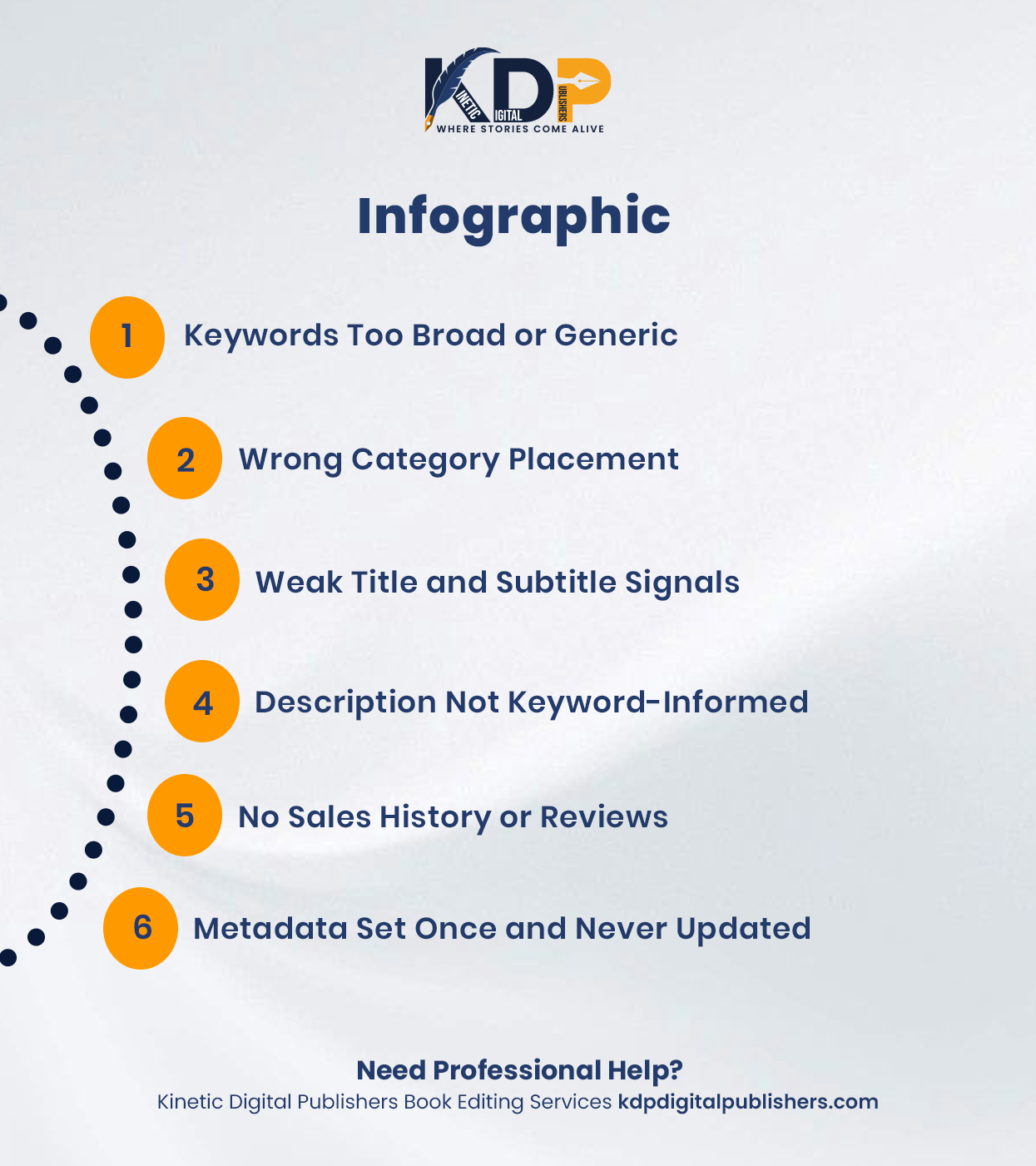
Weak Keyword Research
One of the Top Reasons Why a Book Doesn’t Rank on Amazon? Bad Keywords. A lot of authors don’t know how to pick a great Amazon keyword and use something too general, too competitive, or just plain irrelevant to what readers are actually looking for.
Generic keywords seem like a good place to start, as they’re broad, but this may mean your book is competing against 10,000 well-established authors. Specific keywords: Keyword phrases, instead, help Amazon understand your book and connect you with interested readers. If you do Keyword research with readers in mind – considering exactly what a person interested in a book like yours would search for – and tailor keywords around: Book genre and topic, Book emotional promise, Book audience, Book purpose – your KDP Keyword optimization success rate improves a lot.
Poor KDP Metadata
KDP metadata are the data points that you enter at the point when you publish your book. These cover things such as title, subtitle, author name, description, keywords, categories, and other listing data. This data helps Amazon to know what your book is and where it should be placed.
If your metadata is confusing, incomplete, or not consistent, then Amazon will not know what your book is about. For example, if your keywords say self-help and categories say general fiction, it will not sell well. The various points of your listing have to work together.
Good KDP metadata clearly answers three questions: what the book is about, who the book is for, and why they need to know about it. This way, the book is immediately understood both by Amazon and by readers.
Title and Subtitle Issues
Book title is important for branding, but the subtitle has a huge part to play in book discoverability. A catchy title may sound cool, but if it does not provide an indication as to what the topic or genre of the book is, it may not contribute positively to search ranking.
A good subtitle will give context to Amazon and to your readers. Keywords can be incorporated into your subtitle in a natural way without it sounding unprofessional. Non-fiction book subtitles should generally reflect what is of value/benefit, what the book is about, or who it is written for. Fiction subtitles can help in indicating the genre, theme, or emotional bait of the book.
If your title is too vague and the subtitle does not add much to its clarity, then your listing will not have a high chance of appearing in relevant searches. A strong combination of title and subtitle can bolster your Amazon KDP SEO as well as generate readers’ curiosity simultaneously.
Weak Book Description
Your book description isn’t just a summary. It’s a sales pitch. It tells readers what your book delivers and why it is superior to other options.
A bad description sounds generic. It includes words like inspiring, powerful, or unforgettable, but doesn’t clearly convey the benefits. Good descriptions quickly communicate the core premise, reader benefit, emotional connection, and hook that should persuade the reader.
Your description must also use keywords naturally. Keyword stuffing can appear cheap, but strategic placement can boost your searchability. It also increases the rate of click-throughs and conversions and makes your book more discoverable.
Wrong Book Categories
Another important aspect of Amazon publishing is the categories. Categories are the sections where your book can be displayed. Your book might not be visible to customers who are likely to buy if your category choice is incorrect.
While tempting, choosing a very broad category could make it very difficult to be successful. As a rule of thumb, a narrower category should mean that you have a higher chance of reaching the targeted customer demographic.
Good category selection is one of the most beneficial tips in the Amazon publishing business because it ensures you have good positioning for competition. A category needs to match what the book is, and the readers expect it to match. A misplaced category and customers will simply pass your listing by, and Amazon will struggle to rate it.
Low Sales and Reader Activity
There are a number of factors determining that the book not ranking on Amazon search results besides keywords. Sales numbers, click-through rates, reviews, and reader behavior all affect this. If people can see your listing, click on it, but fail to purchase it, then the listing is unlikely to be seen as a high-performing listing by Amazon.
This shows the importance of presentation. The listing elements that drive reader behavior are your book cover, title, subtitle, price, book description, and the reviews for your book. Keywords are what help the customer to find the listing, but the presentation of the listing must compel the customer to purchase it.
For books with little to no activity, there may be some waiting required before the book gains more visibility. Marketing efforts, building reviews, and constant updating of your listing may all help give stronger signals to Amazon.
Cover and First Impression
A professional cover is one of the most critical aspects of getting your book seen. A reader will generally take seconds to decide if they’ll stop to take a look. If the cover isn’t representative of the genre or is professionally designed, a reader may just scroll past, even if the book is a hidden gem.
The book’s genre and feel must be visually expressed by the cover. A romance novel is going to need a completely different cover design compared to that of a children’s book, memoir, business guide, or fantasy novel. A reader is more likely to click through and for your listing to be viewed more highly when their expectations regarding the genre are met by the cover design. Amazon may list your book, but the cover can very well determine if they move to or keep scrolling past the listing.
Lack of Reviews
Reviews foster trust. A lack of reviews might make a new reader feel like a book is a risky purchase, particularly for an author with whom the reader is unfamiliar. While reviews are just one ranking signal, they are one that impacts purchasing decisions.
Honest reviews can aid in building credibility for your book and increasing your conversion rates, as the conversion rate is a signal for how likely Amazon is to promote your listing to new potential readers. The higher this rate is, the better the book’s authority to show up for certain search terms.
The ethics of building reviews- advance copies, launch teams, newsletters, and contacting people directly who want to read your book.
Limited Amazon Author Marketing
Too many authors “just put it on Amazon” and hope readers will just appear. It rarely does, so you must engage in Amazon author marketing in order to establish awareness, particularly around a book launch. Amazon marketing efforts include social media posts, book trailers, an author blog, your website, email marketing, interviews, podcast appearances, press releases, and the creation of book groups. All of this effort is designed to drive traffic back to the product page of your Amazon listing. This can result in clicks, sales, and reviews that might influence your overall search rank on Kindle. When it’s done on a consistent, targeted basis, it works best.
A Simple KDP Optimization Guide
First, take a good look at your book’s listing. That means examine every element, such as your book title, subtitle, book description, keywords, categories, book cover, book price, and customer reviews. Then, enhance your keywords. Be specific, use long-tail keywords, and remove redundancy and irrelevance from every keyword.
Following that, revise your book description. It needs to be easily understandable, appealing, and reader-centered, clearly communicating the book’s worth and nudging the reader towards the desired action. After that, take a close look at your book’s category settings to make sure your audience is currently exploring the place where your book is listed. Finally, supplement your book’s listing with consistent marketing efforts to give Amazon evidence of some buzz around your book.
Conclusion
If your KDP book isn’t appearing in Amazon searches, the cause usually involves visibility, optimization, or activity. You need to present your book clearly so it can be matched with eager readers. Plus, readers require some sort of incentive to actually click the Buy button.
By utilizing Amazon KDP SEO, a better KDP description, strong keywords for KDP, using better KDP categories, stronger KDP metadata, and Amazon author marketing strategies, you can help increase the chances of your book being discovered.
Finding success with Amazon will require patience and strategy. A well-optimized listing, combined with an active promotional campaign, can be the driving force behind moving your book from invisible to visible, from ignored to seen, from poorly performing to higher read volume.
FAQs
Q1. Why is my book not appearing in Amazon search results even though it is published?
If your book is not appearing in Amazon search results, the most likely reason is that your keywords don’t match what readers actually look for. If you use generic terms, your book competes with many well-established titles. Those books have stronger sales records and lots of reviews. Instead, try specific phrases that perfectly match actual searches. This switch will quickly boost your book’s visibility.
Q2. How does KDP keyword optimization actually improve my book’s ranking?
KDP keyword optimization done using keywords improves your ranking by matching your book with readers’ searches better. Amazon checks your metadata keywords, title, subtitle, and description—to see if they match a search. If your keywords are exact, your book shows up more in relevant searches. This way, it reaches readers who are likely to buy it already.
Q3. How many categories should I use, and how do I choose the right ones for better Kindle search ranking?
Amazon allows two categories during initial setup, and you can request additional categories through KDP support. For better Kindle search ranking, Pick categories where you can fairly compete with others and have a shot at the top spots. Going for a specific sub-category over a broad one helps you stand out—visibility matters more there, even if the broader category has more exposure.
Q4. Does my book description affect Amazon book visibility?
Yes, your description contributes to Amazon book visibility because Amazon’s algorithm reads it alongside your other metadata to understand what your book is about. Writing in the way your target reader really talks strengthens your keyword signals and bumps up your relevance for those searches. This isn’t about stuffing words in weird spots; it’s about truly writing for your reader. When you do that, you naturally use the stuff Amazon favors.
Q5. How often should I update my KDP metadata to maintain good search visibility?
No hard and fast rule exists, but checking your KDP metadata every three to four months makes sense. What worked when you launched might not cut it later on because categories get clogged, trends change, and new books pop up. Smart authors tweak their metadata based on what’s hit, coming back to it regularly to stay visible. Those who set it once and forget about it won’t have the same long-term success.