|
Getting your Trinity Audio player ready...
|
Traditional vs Self-Publishing: Which Path Wins in 2026?
You wrote a book. Great job! Now you need to publish it so people can read it. But how? Should you go with a big publishing company? Or should you publish it yourself? This is a big choice that confuses lots of writers.
Today, self-publishing platforms make it super easy to publish on your own. You don’t need a big company to say yes anymore. Lots of writers choose to do it themselves now because it’s faster and easier.
This guide helps you pick the right path. We’ll look at both ways to publish. You’ll see what’s good and what’s not so good about each one. Then you can decide what’s best for your book.
What Is Traditional Publishing?
Traditional publishing is the old way. A big book company prints your book and sells it in stores. They do all the work for you. Sounds nice, right? But here’s the problem. Getting a big company to pick your book is super hard. They say no to almost everyone who asks.
You also need something called a literary agent first. An agent is like a helper who shows your book to publishers. But finding an agent can take years. Many writers never find one.
How Traditional Publishing Works
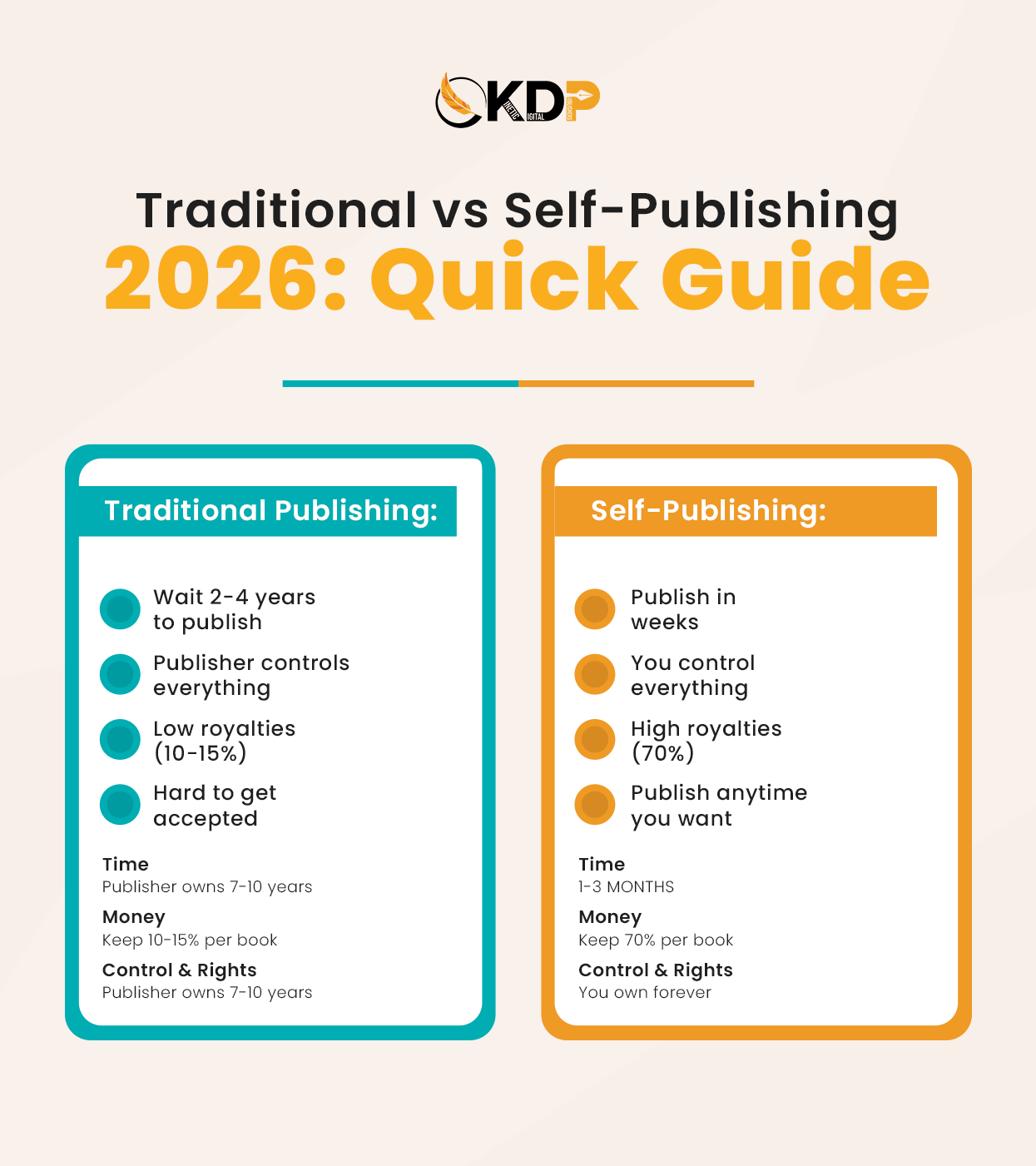
First, you look for an agent. You send your book to lots of agents hoping one will like it. This can take months or even years. If an agent says yes, they show your book to publishers. More waiting. More people saying no. If a publisher wants your book, they give you a contract. This whole thing takes 1 to 2 years just to get started.
Then the publisher edits your book and makes the cover. This takes another year or more. Your book finally comes out 2 to 4 years after you started looking for an agent.
Money From Traditional Publishing
Publishers give you money called an advance. This sounds good, but it’s usually small. Most new writers get $5,000 to $15,000. Some get even less.
After that, you only make more money if your book sells a lot. If the publisher gave you $10,000, you get nothing more until the book makes them $10,000 back. Most books never do this.
When you do make money, you only get 10% to 15% of what the book costs. If your book sells for $20, you get about $2 or $3. The publisher keeps the rest.
What Is Self-Publishing?
Self-publishing means you do it yourself. You’re the boss. You decide everything about your book. Nobody tells you what to do.
Modern self-publishing platforms like Amazon KDP make this really easy. You put your book on their website and boom it’s for sale all over the world in just a few days. No agents. No publishers. No waiting.
You also keep most of the money. On most platforms, you get 70% of what people pay. Sell that same $20 book and you keep $14. That’s way more than traditional publishing gives you.
How Self-Publishing Works
You write your book. You get someone to edit it and make it look nice. You make a cover. Then you upload everything to self-publishing platforms like Amazon or Apple Books.
The platform does the rest. They print books when people order them. They deliver ebooks. They handle the money stuff. You just get paid every month for books you sold.
There’s no one saying yes or no to your book. If your book is ready, you can publish it today. Thousands of writers love this because they’re tired of waiting and getting rejected.
Digital Books Are Taking Over
Digital publishing is huge now. Ebooks and audiobooks sell more than real books in lots of types of stories. People love downloading books right away on their phones or tablets.
This helps self-published writers a lot. Digital books don’t cost anything to make. No printing. No shipping. No storing boxes of books. Every book you sell is pure profit.
Big publishers have a hard time keeping up with digital publishing changes. They move slowly. Self-published writers move fast and try new things all the time.
Who Controls Your Book?
With traditional publishers, they control everything. They pick your cover. They pick your title. They set the price. They even change parts of your story sometimes. Lots of writers hate this.
Publishers also take your rights for 7 to 10 years or longer. During this time, you can’t do anything with your book without asking them. It doesn’t feel like your book anymore.
Self-publishing lets you keep control forever. Don’t like your cover? Change it tomorrow. Want to make your book cheaper? Do it in 5 minutes. Your book stays yours.
Making Your Own Choices Matters
Big publishers want books that fit in boxes. They want what’s selling right now. If your book is different or new, they say no.
With self-publishing solutions for authors, you write what you want. No editor telling you to change your ending. No marketing person saying you need to add romance to sell more copies. This freedom is why lots of writers who care about their stories choose self-publishing.
How Long Does Publishing Take?
Traditional publishing: 2 to 4 years from finding an agent to your book in stores. That’s crazy slow. Self-publishing: 1 to 3 months from finished book to published. Some writers do it in just a few weeks. The difference is huge.
Speed matters because things change fast. If you write about something popular now, waiting 3 years means nobody cares anymore.
Why Being Fast Helps in 2026
Publishing trends in 2026 like speed. Readers want new books all the time. Writers who publish lots of books get more fans.
Big publishers can’t keep up. By the time they publish your book, you could have written two more on your own. Self-publishers can change and try new things faster.
The latest book publishing trends show people reading more books than before. Publishing fast means you can give them what they want right now.
Are Self-Published Books Good Quality?
Some people say self-published books aren’t as good. This used to be true. Old self-published books looked cheap and had lots of mistakes.
Not anymore. Professional book publishing services let self-published writers hire the same editors and designers that big publishers use. The difference is gone.
Many bestselling self-published books look exactly like books from big publishers. Readers can’t tell which is which. Good quality comes from hiring good people, not from who publishes you.
Getting Help From Pros
You don’t need a big publisher to make a nice book. You can hire editors, designers, and formatters yourself. They make your book look amazing.
Self-published writers who pay for quality beat traditionally published books all the time. It’s about doing it right, not about who your publisher is.
The trick is knowing when to do it yourself and when to hire experts. Smart self-publishers build teams of helpers who make their books shine.
Which Way Makes More Money?
Traditional advance: $5,000 to $15,000 if you’re lucky. Then maybe nothing ever again. Total money: $5,000 to $20,000 for most writers.
Self-publishing: No advance money upfront, but you get 70% of every sale forever. Sell 1,000 books at $5 each and you make $3,500. Sell 5,000 books and you make $17,500. No limit on how much you can earn.
The most successful self-published writers make millions. Traditional writers need to sell tons of books to make that much because they get such a small piece. The math works better for self-publishing.
Making Money Over Time
Traditional books don’t last long. Publishers give your book 3 to 6 months to do well. If it doesn’t sell big, they forget about it. Your book dies.
Self-published books sell forever. They’re always on Amazon Kindle Direct Publishing platform. Sales might be slow but they never stop. Money coming in for years.
You can also change prices whenever you want. Have a sale, try different prices, test what works. Traditional writers can’t do any of this stuff.
Who Does Marketing?
Big publishers used to do marketing. Not anymore. Unless you’re already famous, they don’t help much. You have to market yourself anyway.
Self-published writers do all the marketing themselves. This sounds scary but it’s the same work traditional writers do too. The difference? You keep more money from books you sell.
Both ways need you to tell people about your book, use social media, and get readers excited. There’s no easy path where someone else does it all.
Building Your Fan Base
No matter which way you publish, you need fans. Email lists, social media followers, and people who love your books matter more than your publisher.
Self-publishing platforms let you see who’s buying your books. You can talk to them directly. Traditional publishers keep this information secret.
This direct connection helps self-published writers build loyal fans faster. You own the relationship with readers, not some company.
Getting Into Bookstores
Traditional publishing gets your book into stores. This used to be super important. But stores matter less every year now.
Most people buy books online these days. Amazon, Apple Books, and other websites sell the most books. Self-published books show up there just like traditional ones.
Real bookstores only have space for a few books anyway. Even traditionally published books fight for shelf space. This advantage isn’t as big as it used to be.
Online Is Where It’s At
Digital publishing makes bookstores less important. People browse and buy on their phones and computers. Your book doesn’t need to sit on a shelf to succeed.
Self-published writers actually do better online sometimes. You can lower prices fast, run sales, and try new things quickly. Traditional publishers are too slow. The future of books is digital. Self-publishing puts you in the perfect spot for this.
Does It Matter Who Publishes You?
Traditional publishing makes some people feel special. Being “chosen” by a publisher proves your book is good. Some writers really want this.
But feeling special doesn’t pay your bills. Readers care about good stories, not who published them. Amazon reviews matter more than the publisher’s name on your book.
Self-publishing isn’t looked down on anymore. Bestseller lists have tons of self-published writers. Good books win, not publishing labels.
What Really Makes You Look Good
Great books make you look good. Loyal readers make you look good. Sales and reviews make you look good. Your publisher doesn’t matter if your book is awesome.
Lots of self-published writers make more money and have more fans than traditionally published ones. Success is louder than labels.
In 2026, readers don’t check who published a book before buying. They read what it’s about, check reviews, and decide. They can’t even tell how you published.
Doing Both: The Mix Path
Some writers do both traditional and self-publishing. They traditionally publish some books while self-publishing others. This mix gives you the best of both worlds.
You can try self-publishing first. If you do well, traditional publishers might want you. You negotiate from a position of strength instead of begging.
Mix-path writers make the most money. Self-published books pay better. Traditional deals bring credibility and sometimes bookstore placement. Why pick just one?
Building a Career With Both
Start with self-publishing to learn how it works. Build your fans. Prove your books sell. Then traditional publishers take you seriously.
Or go traditional first, get your name out there, then self-publish to make more money per book. Both ways work depending on what you want.
The point is you’re not stuck with one choice forever. Publishing is flexible now. Change as your career grows.
Which Way Wins in 2026?
For most writers, self-publishing wins. It’s faster, pays more, gives you control, and modern self-publishing platforms work really well.
Traditional publishing still makes sense if you want the special feeling, have years to wait, and don’t mind giving up control for a small advance.
But honestly? Technology and publishing trends favor doing it yourself. The tools exist. The platforms work great. The money is better. Self-publishing is the smart pick for 2026.
How to Decide
Think about what matters to you. Do you want speed or that special publisher feeling? Control or validation? More money or publisher support?
Look at successful writers in your type of book. How did they publish? What worked for them? Do some homework before deciding.
For complete help with either path, check out self-publishing solutions for authors that walk you through everything step by step.
Getting Started
Once you decide, just do it. Don’t think too much. Both paths need the same first step: finish writing your book. Then pay for good editing and design. Quality matters no matter how you publish. Readers deserve your best work.
If you pick self-publishing, learn about different self-publishing platforms. Each one has different features and pays different amounts. Pick the ones that fit what you want.
Conclusion
The traditional vs self-publishing question has a clear answer in 2026. Self-publishing platforms, digital publishing growth, and new publishing trends all help independent writers.
You publish faster, make more money, keep control, and change quickly. Book publishing services give you professional quality without giving up your rights or most of your money. Traditional publishing is still around, but it’s slower, pays less, and wants too much control. For most writers, it’s not worth it anymore.
Ready to start publishing on your own? Consult Kinetic Digital Publishers today to explore Kinetic Digital Publishers self-publishing services that give you professional quality while keeping you in charge. Your book deserves to be published your way.