|
Getting your Trinity Audio player ready...
|
Complete Guide to Book Editing & Proofreading: What Every Author Needs to Know
Kinetic Digital Publishers · Authors’ Editing Manual · Self-Publishing Guide · United States
It took you months, or perhaps years, to write your manuscript. Each word was written out of your true inspiration. Now you are near the end, yet before publication, there is one more thing that most beginners usually rush through, or don’t do at all. This step is known as editing.
Good book editing services are not just about fixing a few spelling mistakes. This process is about ensuring that your novel sounds as intended by you. It is about giving your reader a pleasant experience throughout their entire reading journey. Because the fact of the matter is that if something’s not right, then readers are bound to notice.
Here we are going to talk about editing, the concept, the necessity, differences between editing and proofreading, and everything you need to know for your book to be really ready before being published on Amazon.
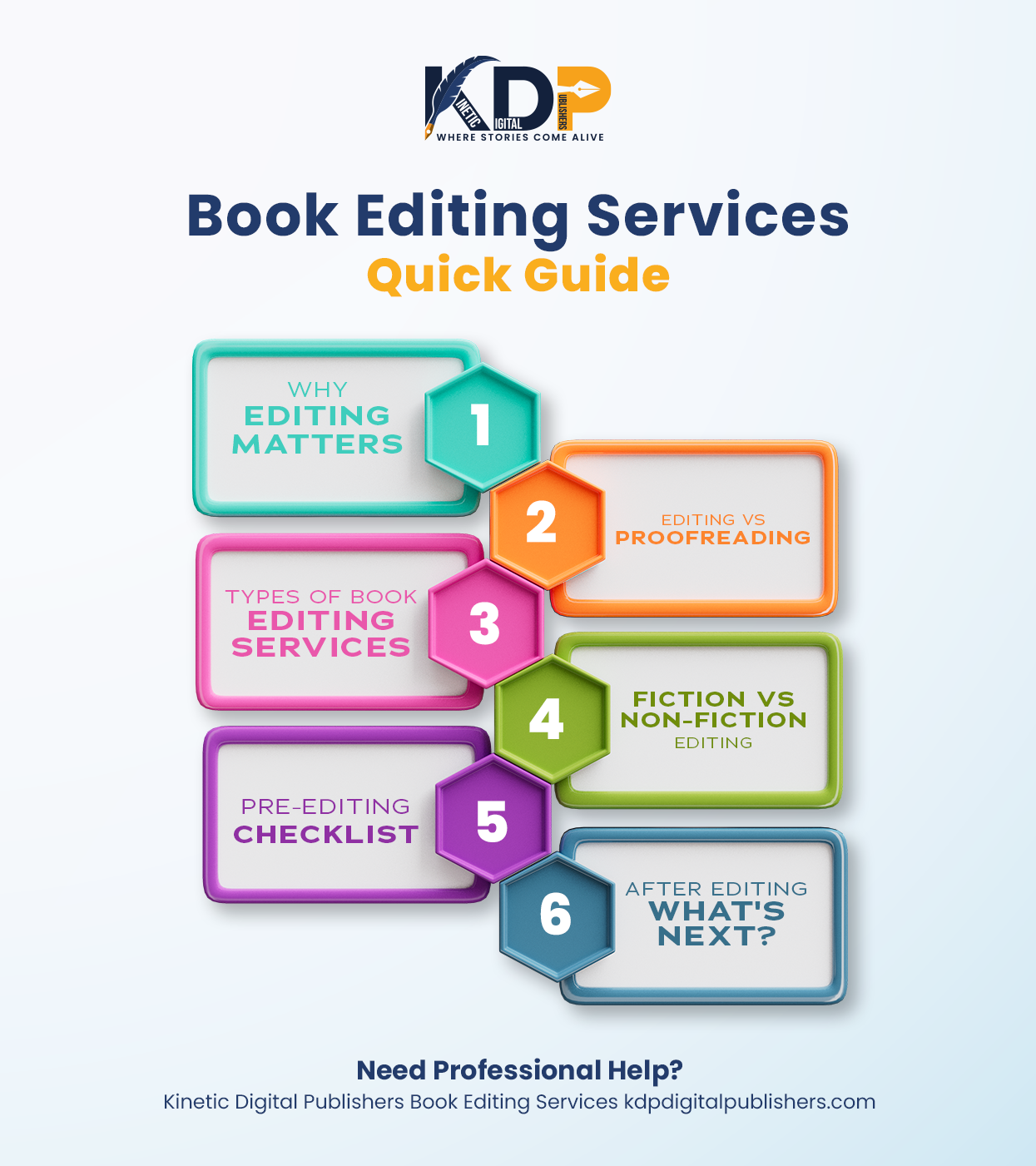
Why Editing Is the Step You Cannot Skip
A lot of writers think their job is done once the last chapter is written. And honestly, that feeling makes sense. Writing a full book is hard work. But finishing the draft is actually just the beginning of the real publishing process.
When you write, your brain already knows what you meant to say. So when you go back and read your own work, your eyes skip over mistakes because your mind fills in the gaps automatically. You see what should be there, not what’s actually on the page. This is completely normal. It happens to every writer, no matter how experienced.
That’s exactly why professional editing services exist. Fresh eyes, on the other hand, won’t miss anything. Your readers may not even know where you went wrong; however, they’ll be able to tell that something didn’t seem right.
Editing vs Proofreading — What’s the Real Difference?
It is one of the most frequent concerns for writers, and it is a good question indeed. The difference between the terms may sound confusing due to the high frequency of their usage together. Editing comes first as it implies making changes on a bigger scale. A professional editor analyzes your writing in search of flaws in plot, logic, coherence, characters’ consistency, and clarity of the author’s message. In the case of non-fiction books, an editor evaluates the structure of information provided and its efficiency. In other words, editing is thorough. It includes relocations, deletions, additions, and even rewriting.
As opposed to editing, proofreading comes afterward. It implies minor corrections in spelling, grammar, punctuation, and formatting of the manuscript. At this stage, most serious flaws have already been corrected, so the task of proofreaders involves polishing the text before its publication.
Here is one more analogy that may help you understand the difference better. Editing is about fixing a house, while proofreading is about making it clean before inviting guests inside.
The Different Types of Book Editing Services
Not all editing is the same, and knowing which type your book needs can save you time and money. Here’s a simple breakdown.
Developmental Editing is the deepest level. It looks at structure, pacing, character development, and overall flow. It typically happens at an early stage and may even occur before the first draft has been completed. If your story seems to be lacking something and yet you cannot put your finger on it, then that’s the kind of editing you require.
Line Editing involves editing of the content of the writing itself, including the sentences, choice of vocabulary, and flow. What a line editor does is make your writing crisp and more interesting to read without in any way altering your style. Line editing is ideal for writers whose stories are well-crafted and only need a bit of polish in terms of writing.
Copy Editing involves checking grammar, spelling, and punctuation, as well as consistency in such matters as character names and numbering of chapters. Copy editing is quite meticulous.
Proofreading comes last. By the time a story reaches this point, all other stages of editing have been completed, and all that remains for the proofreader is to ensure that there are no omissions and that there are no errors that might slip into the story.
These are usually undertaken by most books before they become fully prepared for publication. In case you are unsure of what stage your manuscript is currently in, you can go ahead to prepare your manuscript with the help of skilled editors.
How Bad Editing Hurts Your Book — Real Talk
Let’s face the reality of the consequences that an untidy book might create. No wonder, poor editing makes a book look less professional, but more importantly, it drives away readers, reviews, and sales.
A single poor review that says that the book is full of typos or sentences that confuse readers may haunt the book forever. Reviews on Amazon about unpolished books spread rapidly. There is no way you can get rid of those reviews once posted. Future readers find them and do not buy the book anymore, thus leaving it without any potential.
In contrast, a book free from mistakes gains a reputation among readers. They appreciate the effort put in and leave great reviews for the book. That’s the difference good manuscript editing makes; it’s not just about the words on the page, it’s about the entire experience you’re giving your reader.
Can You Edit Your Own Book?
Yes, technically speaking. However, it is extremely difficult to perform properly. As we mentioned above, your mind sees things in terms of its expectations rather than what it actually is that is being shown to it. Therefore, self-editing always faces certain limitations despite one’s best intentions.
However, self-editing is definitely worth considering. Before sending the manuscript for professional editing, take a few rounds of reviewing and editing by yourself. Read it aloud to spot sentences that sound weird, even if they look fine when you read them silently. Give yourself some time between each revision round to have a fresh eye for the manuscript. Print it out if possible, since mistakes might appear more easily on paper.
Self-editing should always be considered preparatory work before handing the manuscript to an expert for the final review. Imagine it like cleaning the house prior to the cleaner coming – you do everything in your power, and only then does the expert come in and fix everything else.
Here’s the Thing Most Authors Find Out Too Late
What is fascinating about writing your own book is that it is usually during its publishing that most writers come to terms with the fact that they require proper editing to bring out their best. After the publication and poor reviews follow, they tell all those around them to read the book.
However, there is no need to become one of these writers; you do not have to wait until people start sending poor reviews of the book you worked so hard on. We offer professional book editing services, which will help you get that professional eye of an expert on your text.
A good edit can make a huge difference and help you avoid all the mistakes you may have been making while working on your text alone. It will also give you more confidence in the content, especially since we guarantee high-quality results.
No matter what type of literature you wish to publish, you will need our book editing services. Our professional editors can handle all types of manuscripts equally well.
What Makes a Good Book Editor?
Every editor may not be a suitable one for your work. A good editor appreciates your genre and your way of writing and is an efficient communicator. He or she does not edit your book from his or her viewpoint but enables you to reach perfection in your writing.
When looking for proofreading services USA, you can ask for examples of the editorial services they have provided in the past. It is crucial that you know whether they have worked with your genre before. An effective editor will show you their style by providing you with an example of the first page or two edited.
Most of all, however, an editor will make you feel safe, never like you are being put under scrutiny. It is about making the book better, not putting down the author.
Fiction vs Non-Fiction — Does Editing Work the Same Way?
Excellent question, and the answer is somewhat, but not entirely. The purpose of an editor is somewhat similar, yet there are subtle differences between the two roles.
Fiction editors carefully consider whether the plot is consistent and believable, whether the characters make sense, whether the pacing is appropriate, and how the dialogue sounds. Does the storyline make sense? Do people get emotionally involved with the narrative? Is the resolution satisfactory for the audience? These questions are considered by fiction editors.
Non-fiction editors look more closely at logical consistency, organization, and coherence. Is the material true and correct? Do readers understand the information presented? Do the chapters connect logically from one to the next? People who buy non-fiction books read them for information. Good non-fiction editors make sure readers gain knowledge from their books.
In both cases, books require final proofreading and copyediting. Writing is writing regardless of genre.
When Should You Start the Editing Process?
The answer straight off the top of your head, right after writing your initial draft. No need to worry about having everything worked out in your head perfectly yet. Write down what you think first, then do your editing. Writing and editing simultaneously will most likely cause you to slow down on both tasks.
Take some time off from your manuscript once it’s been written. Return to it later when you’re able to, run through it with a self-edit, and send it off to an expert editor. Bringing your manuscript to an editor as early as possible gives you ample opportunity to make your book fantastic before its release.
If your aim is to publish your book via Amazon KDP, keep in mind that other aspects of your book, such as its cover, format, and promotional efforts,s must also be planned for. Book cover design, formatting, and publishing support services can all be taken care of in one stop.
Your Pre-Editing Checklist
Before submitting your manuscript to your editor, there are several simple tasks you can complete prior to starting the editing process.
- Complete a spell check
- Read the entire document at least twice
- Strip out all personal notes from the manuscript
- Make sure the chapters are in the proper sequence
- Carry out checks to ensure consistency with names and other key information
By completing these tasks prior to the editing process, you will be saving your editor precious time. The tasks that can be done easily by yourself should be done by yourself, since this can save money in the long term.
After Editing — What Comes Next?
Once your manuscript is thoroughly edited and perfected, you can move forward to the next stage of publishing your book. This stage includes formatting your book according to the publishing platform you will use, preparing the final version of your cover, writing an engaging description of the book, and developing a marketing strategy.
Without a marketing strategy, the publishing of your book will be like opening a shop but failing to make everyone aware of its location. Every book needs some help. Marketing your book once published can be done using proven techniques specifically for self-published books in the US.
If at any point in this process you feel that you need help, you should feel free to contact our experts at Kinetic Digital Publishers.
Conclusion
Your book deserves to be read. But more than that, it deserves to be read in the best possible version of itself. That’s what good book editing services give you. A manuscript is not only better in appearance but also stronger and more compelling.
Whatever kind of editing service you may require for your manuscript, developmental or basic proofreading, do not deprive yourself of it. Those authors who work on their books prior to launching them on the market are the ones who gain a strong base of readers and achieve success.
Discover the book editing services offered by Kinetic Digital Publishers right away!
FAQs
What is the difference between editing and proofreading services?
Editing involves the analysis of the overall structural integrity, coherence, and readability, as well as the story. Proofreading is the last stage of editing, which focuses on fixing any spelling, grammatical, and punctuation issues. Both editing stages are essential before publishing a book.
How much do professional book editing services cost in the USA?
Costing is contingent upon the nature of the book and the type of service requested. The costliest editing option is development editing, and proofreading is relatively cheaper. The best move would be obtaining an estimate from an established editing service provider.
Do I really need manuscript editing if I’m self-publishing?
Yes, in fact, maybe even more than that. Established publishers have in-house editing staff members, but self-published authors need to engage these services. Failure to do so is the most frequent reason why self-published books receive bad reviews.
How long does book editing take?
That will depend on your manuscript’s length and the kind of editing service required. As far as a novel goes, the minimum turnaround time ranges from one week to one month. Plan accordingly.
Can Kinetic Digital Publishers help with book editing services for my manuscript?
Absolutely! At Kinetic Digital Publishers, we offer book editing services for fiction and non-fiction authors in the United States.