|
Getting your Trinity Audio player ready...
|
Book writers choose the topic according to their mood of the day. After completing the work and uploading it to Amazon, they find that the book was not even in demand. This does not mean that the writer was not a good writer and the topic selected was a bad choice, but there was no need for such a book.
The authors who build a consistent income on Amazon KDP do something different. They research before they write. They find profitable book niches where real readers are actively searching, where there is not too much competition, and where the book can stand a real shot at making the rankings and getting found.
This book takes you step-by-step through the entire process of doing this research correctly, the methods, the steps, and the mindset that separates successful writers from unsuccessful ones.
Why Niche Selection Matters More Than Writing Quality
This is a difficult thing for many authors to accept – but it is very true indeed. A fantastic book in the wrong genre will never perform as well as a decent book in the right one. Amazon is a search-oriented site. The buyers will look up things they want – and if they cannot locate your book because it’s in the wrong genre, you won’t be found, no matter how good it is.
Amazon KDP niches are not all created equal. They may be crowded with bestselling titles that have had many reviews and a long history of sales. As a new author, trying to compete in these genres is quite tough. Other genres have enthusiastic readers who lack enough good books to satisfy their needs, which are the niches for a new writer to rise to fame and make sales.
The Difference Between a Topic and a Niche
A topic is always broad. “Personal finance” is a topic. “Budgeting for single mothers in their thirties” is a niche. In a topic, there could be millions of readers and hundreds of books vying for those readers. In a niche, there is one definite reader with one definite need.
The authors who find profitable book niches consistently are the ones who understand this distinction and apply it every time. They don’t ask themselves, “What should be my topic?” Rather, they ask themselves, “Who is the specific reader for whom I’m writing, and does he/she seek out a book like mine on Amazon?”
Step One — Start With Amazon’s Own Search Bar
The best tool for researching a niche for KDP writers is entirely free and accessible to everyone; this is the search function on Amazon.
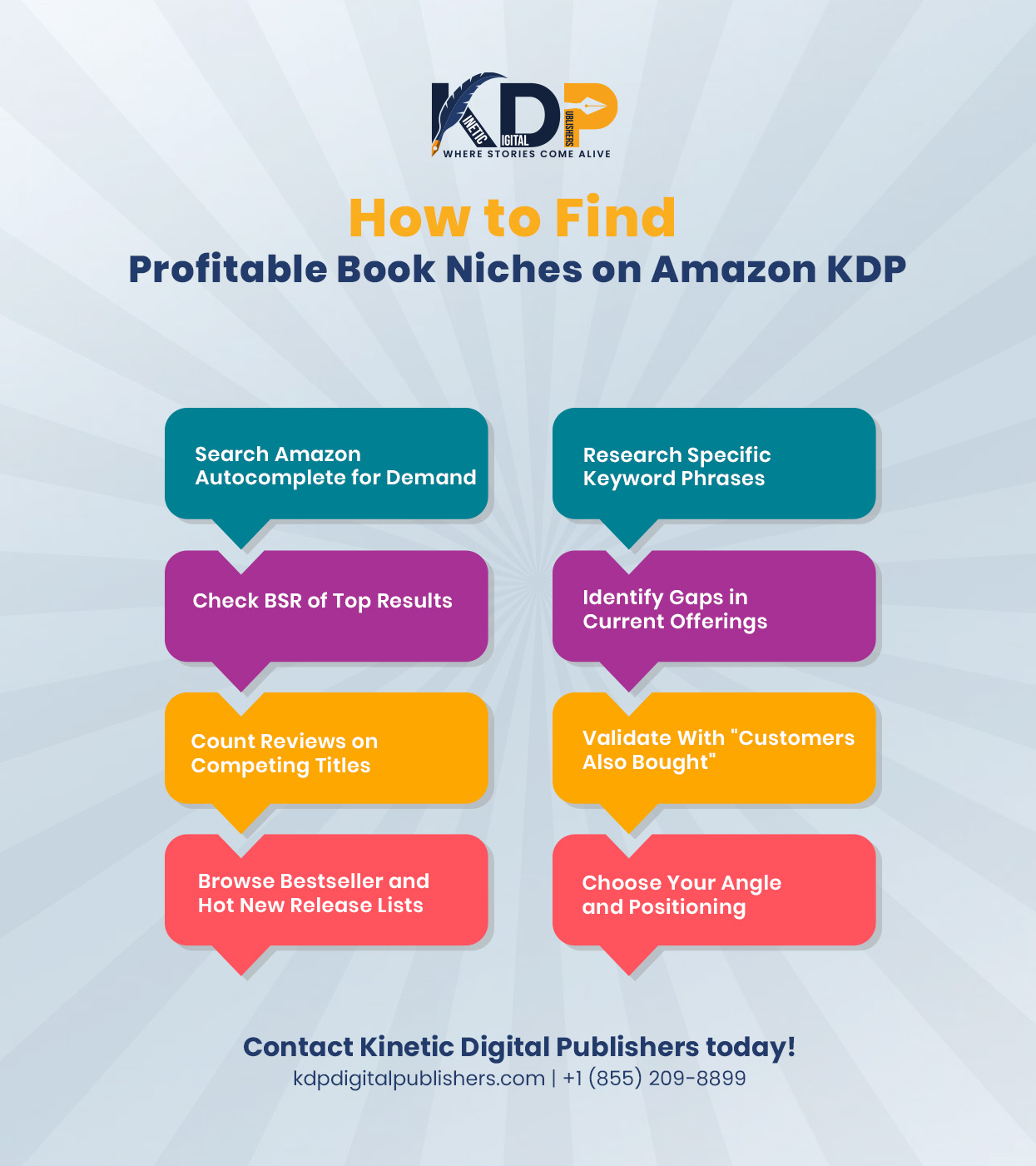
Go to Amazon’s Kindle store and type phrases into the search box. Look at the auto-complete suggestions that appear. The reason why these suggestions come up is that there are enough people looking for this phrase for it to make an impact on Amazon’s algorithms.
What the Autocomplete Tells You
An autocompleting phrase means that there is demand for it. If there is no autocompletion on the phrase, it could be that there is not enough search volume to develop organic traffic. It is very easy to do – type in your topic and watch Amazon’s suggestions, which is one of the fastest ways to identify Kindle publishing ideas that have a built-in reader base waiting for them.
Note the differences here. For example, if you type “mindfulness for” and the results show you “mindfulness for anxiety,” “mindfulness for teens,” and “mindfulness for beginners,” then you have three separate niches in one broad category with their own audiences and unique competition.
Step Two — Analyze the Competition in Each Niche
The first step to creating a niche market is identifying whether there is demand in the market for it. The second thing would be analyzing how competitive the niche is.
When you search for a specific phrase on Amazon and look at the results, two numbers matter most. The first is the Amazon Best Sellers Rank (BSR) of the books appearing in those results. A BSR below 100,000 generally signifies that a book is regularly selling. Several books with such BSRS within your target niche suggest that people are indeed purchasing in the niche.
Finding the Opening in a Competitive Space
Number two is the reviews of the books that you see ranked on your search results page. In case all ten are rated by at least five hundred people and are older publications, the niche is established, and you are about to enter tough competition. In case there are several publications with fewer than fifty reviews and rather recent ones, you may want to position yourself well in this niche.
Self publishing niches that offer the most promise for aspiring authors actually have high demand and relatively low competition. This can be seen through search volumes and BSR, as well as low review counts. Finding that combination is what separates profitable book niches that produce results from ones that look appealing but offer no realistic opening.
Step Three — Use KDP Keyword Research to Validate Your Niche
Before deciding on your niche, make sure you validate it by conducting some research on keywords. Knowing what particular phrases are used by people to search for books within your chosen niche not only confirms its viability but also helps you craft a title, subtitle, description, and backend keywords.
KDP keyword research does not require paid tools, but even with tools such as Publisher Rocket, you’ll be able to conduct useful research within a much shorter timeframe. Amazon search engine, Google autocomplete search, as well as the customers’ suggestions of what else they bought and what else they were searching for on books’ pages, all serve the purpose.
What Good Keyword Research Tells You
Keyword research reveals three key pieces of information. It lets you know what terms people are using to search for something that your book can be — the actual terms they use when searching for your type of book. It lets you know how competitive each term is — how many existing books are optimized for that term.
This is the foundation of any real Amazon author strategy built around organic discoverability. Keywords that you pick up from research will determine the structure of the listing of your book, and listings constructed using properly researched keywords will attract the correct audience without paying for each individual click.
Step Four — Study Bestselling Book Categories for Hidden Opportunities
Bestselling book categories on Amazon are updated hourly and are publicly visible to anyone. Scanning through these lists may be one of the most useful ways to conduct book market research, and most writers never even consider doing it.
While scanning through bestseller lists by categories, be sure not only to take notice of those at the top of the list, but also of the books that occupy positions twenty through one hundred. What makes these books popular? Take note of their subject matter, their subtitles, and the angle they are trying to cover.
The Category Research That Reveals Real Gaps
Navigate to the “Hot New Releases” tab in the categories that interest you. This will help you identify which products currently have momentum; i.e., which books are being sold quickly. Seeing several new releases with momentum in a certain sub-category lets you know that readers in the category are reading and purchasing new products as opposed to just revisiting their favorites.
Find a category in which the top-selling books have a low number of reviews but a high BSR rating. This is an indication that the category is seeing purchases, but the competition isn’t yet too formidable, thus giving you an opening if your product is researched well enough.
Here Is the Step Most Niche Research Guides Skip Entirely
Here is something most articles about niche selection for books do not say directly: Research shows you where the opportunity is, but it doesn’t show you how to market your particular book to capitalize on the opportunity. The position, the angle, the title, the subtitle, the cover, the description, this is how the niche becomes profitable.
Fortunately for you, the research services of Kinetic Digital Publishers don’t just locate where the niches are profitable. We work together with our authors to understand where the demand exists, and not just that, but we help you understand how you can position yourself in these niches to take advantage of the demand immediately after publishing. This is why research with us leads not to a good idea that remains invisible on Amazon because the position wasn’t done correctly, but to an actually published book.
Non-Fiction vs Fiction — How Niche Research Differs
KDP success looks slightly different for non-fiction and fiction authors — and the niche research process reflects that.
Non-Fiction Niche Research
Finding the validation for non-fiction niches is easy since the readers will be searching for what exactly they need from non-fiction. Non-fiction authors can validate the demand for their book simply by doing a search for the problems their book will solve and analyzing Amazon’s suggestions in relation to the number of books on that topic.
A great opportunity in non-fiction writing involves the presence of three components: the reader, the problem they have, and the solution that hasn’t been offered sufficiently yet in existing books in that niche. If the book you write serves a specific reader more than any other book currently out there in an in-demand niche, your book is set up for success.
Fiction Niche Research
The niche market research in fiction writing involves a closer study of how particular genres work, reader preferences in certain types of genres, and how particular tropes and subgenres of those genres are actively being consumed by people at the moment.
Authors who write fiction and want to conduct niche market research on their target genre need to examine the “also bought” series of popular books in the targeted genre, interact within the community of fans of these books, and figure out which particular tropes are actively being sought after.
Conclusion
A well-written book in a poorly chosen niche will always struggle. A well-positioned book in a profitable book niche with real demand and manageable competition has a genuine, sustainable pathway to discovery, purchase, review, and recommendation without investing heavily in promotion or marketing due to the lack of a current following.
It is not difficult to undertake. It is a methodical approach to discovering something about your book’s market presence that will inform all future decisions — the title, cover design, keywords, and so on. In essence, it provides the clarity that comes with knowing where your book stands in relation to its competition.
When you need an experienced hand helping you identify the proper niche for your new book and position it to be competitive from day one, please consider turning to the experts at Kinetic Digital Publishers Book Niche Research Services.
FAQs
Q1. How do I find profitable book niches on Amazon KDP as a new author?
Use the Amazon search bar and enter some topic words that are relevant to your book, then observe the autocomplete options. These are actual words being used by readers. Look at the books that show up from this process and their BSR and review scores. Profitable book niches for new authors combine strong search demand with manageable competition. Books in the top results with fewer than one hundred reviews and recent publication dates signal an accessible opening.
Q2. What makes certain Amazon KDP niches more profitable than others?
The most profitable Amazon KDP niches have three qualities: There is active demand among readers, indicated by high search volumes and good BSRs; a low level of competition, not too many established books with lots of reviews; and a sufficiently targeted topic to allow a properly positioned new book to succeed organically. Generic subjects are generally more competitive. Targeted niche markets with an identified audience and their needs provide better chances for an author.
Q3. How does KDP keyword research help me choose the right niche?
KDP keyword research validates whether the demand you identified in category browsing is being driven by specific searchable phrases — It tells you what the phrases really mean. By understanding the specific terminology that your target audience uses to search for similar publications to yours, you will be able to optimize your listings on the basis of these phrases from the very moment your book is published. Pre-writing research is much more helpful than post-writing research, as it may influence the titles, subtitles, and even the content of your book.
Q4. Which bestselling book categories are most accessible for new self-published authors?
Bestselling book categories, however, for aspiring authors, the best entry point would always be within the various sub-categories, rather than the broad top-level categories. In self-help books, sub-topics such as productivity books for particular target groups, or mindfulness in certain contexts, might have existing readership and less competition. When it comes to novels, some romantic sub-genres that have unique tropes may have an existing passionate following. Sub-topic bestsellers and hot new releases can also indicate particular niches worth exploring.
Q5. How many niches should I research before committing to one for my book?
Investigate at least five to ten different possible niches before settling on anything, because it is often not the most obvious niche that ends up being the best one. Every niche that you investigate will show you a bit more about how to analyze the next one, and by comparing them, you’ll be able to see which combination is the best choice. Niche selection for books is an investment of time upfront that directly shapes every result your book produces after it goes live.