|
Getting your Trinity Audio player ready...
|
Why 90% of Self-Published Authors Don’t Make Money (And What the Top 10% Do Differently)
Every year, hundreds of thousands of self-published authors upload their books to Amazon and wait. They log into their sales dashboard every morning. They reload the page, hoping to see something new. And most of them – the true percentage figure probably hovers around the ninetieth mark – will never earn more than a couple of hundred dollars on their book. A lot of them earn nothing at all.
And this is not due to any lack of quality in their writing. This is not due to self-publishing being an impossible avenue to pursue. The fact of the matter is that there is a fundamental difference between the ninetieth percentile and the top ten percentile, and most of them have absolutely no clue about it.
What this guide aims to do is to tell you exactly how the authors who generate actual income from their books differ from those who write, then release, then abandon hope. But even more importantly, it will tell you exactly what you need to be doing differently.
The Myth That Good Writing Is Enough
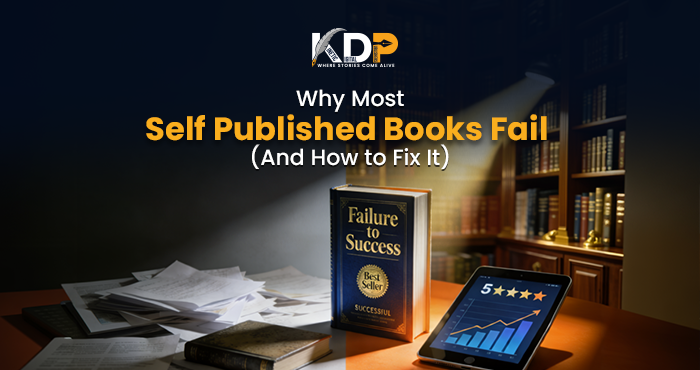
The first thing most struggling self-published authors believe is that a well-written book will find its audience on its own. Provided it’s good enough, people will find it. The algorithm will find it. People will talk about it.
This is the single most costly mistake you can make in self-publishing. Amazon has hundreds of thousands of books listed on it. You cannot be found if you’re not first found – and you can’t be found unless you’ve been positioned, presented, and promoted effectively.
What Publishing Actually Is vs What Most Authors Think It Is
Publishing is the endpoint, most writers believe. Create the book, publish it, and it’s all over. But the best ten percent know that publishing is the starting point. And the hard part begins only after publishing — there’s no end to it.
This is the difference between the ninety percent and the ten percent. One is waiting for something to happen; the other makes things happen.
Why Self Published Books Fail — The Real Reasons
Before we talk about what the successful ten percent do, it helps to be honest about what the struggling ninety percent consistently get wrong. Why self published books fail is not a mystery — it is a pattern, and it looks almost the same across thousands of underperforming titles.
The Cover That Does Not Earn the Click
This means that readers scroll through Amazon pages much in the same way as they browse products in an actual store — fast, visual, and mostly without much thought at all. Your cover will be the last thing readers will look at before moving to the next listing if it’s unappealing, unattractive, or doesn’t fit in its genre.
If you are a struggling author, chances are your book has a cover problem that you may not even know about. After all, most of you designed your covers based on what you liked — not on what will attract readers into buying your books. The difference between these two things couldn’t be more significant.
A Description That Explains Instead of Selling
Amazon’s book description is not a book summary but rather a pitch for your book. Most of the struggling writers actually write their book summaries.
The summary of your book describes what your book is all about, while a sales pitch elicits an emotional response that pulls the reader towards buying your book. The top ten percent of self-published authors treat their description like a copywriter would: hook first, value second, call to action third. The ninety percent treat it like a book report.
Keywords That No One Is Searching For
Amazon is a search engine, which means that your book will only show up to people searching for it if the keywords you choose happen to match what these users are typing into the search bar. Broad, generic terms such as “fiction” or “business” are too wide-ranging to compete effectively. More specific terms, such as “cozy mystery taking place in a small southern town” or “leadership advice for first-time managers,” attract readers seeking the very book you have written.
This is one of the most common author income mistakes, and it is one of the most fixable. The right keyword strategy costs nothing to implement and can meaningfully change how many readers find your listing every single day.
What the Top 10% of Self-Published Authors Do Before They Even Publish
The primary factor that differentiates between the successful and unsuccessful authors is frequently not related to their books at all. Instead, it lies in their actions before the book’s release.
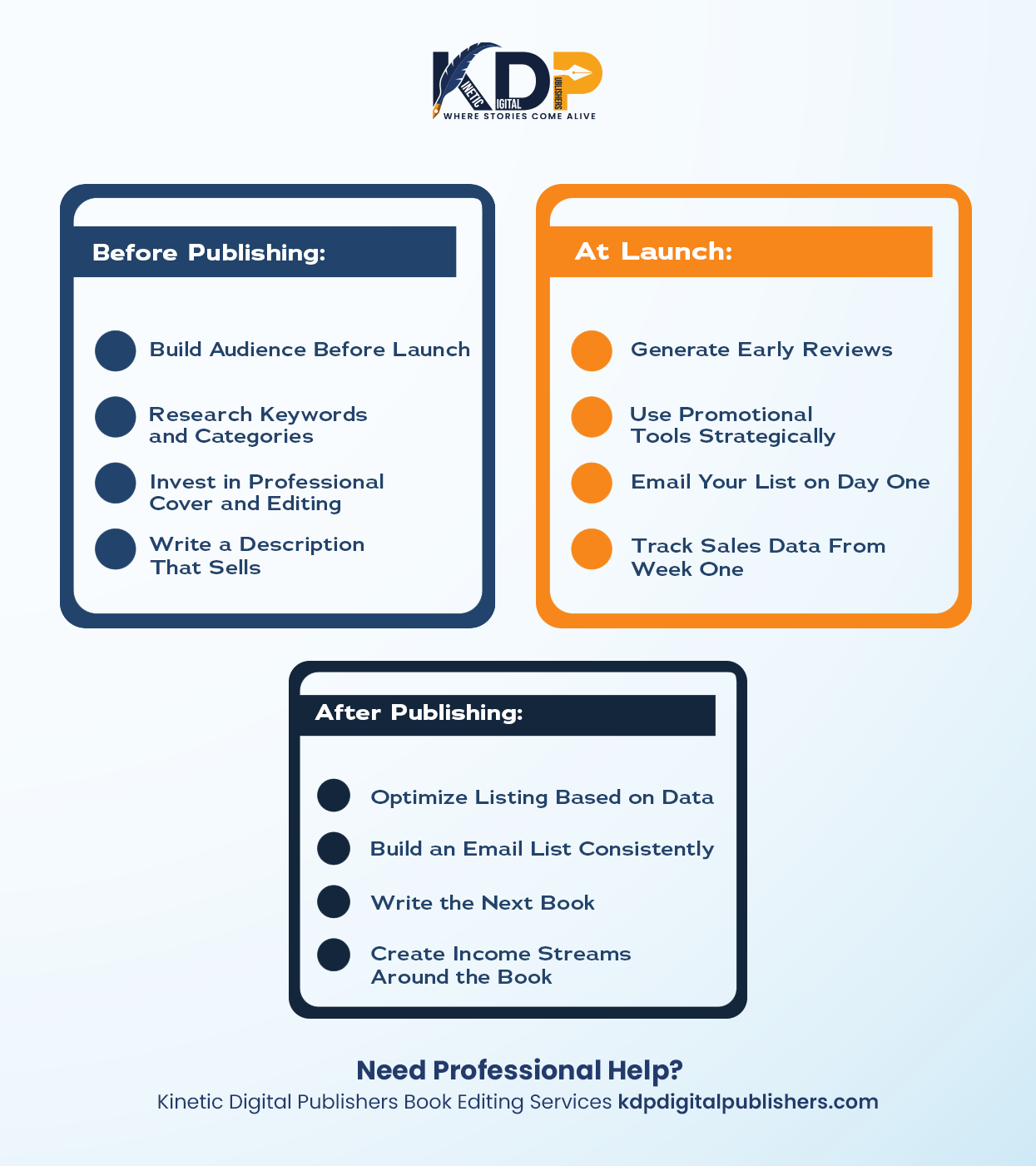
They Build an Audience Before Launch Day
Successful self-published authors in the top ten percent do not announce their book on launch day and hope for the best. For weeks or even months prior to its launch, they work to generate interest in the title — explaining what the book is about, what makes it relevant, who would be interested in it, and how it can improve the lives of its readers.
Once the book launches, they already have a receptive audience eager to purchase it during the first forty-eight hours after its launch. This high sales velocity is a signal to Amazon’s algorithms that they should feature it even further.
They Treat Their Book Like a Business, Not a Project
A project has an endpoint. A company never ends, but operates constantly. Those who generate a reliable source of income from their books are fully aware that writing is a continuous process – it is a company with its own product, consumer, marketing technique, and a way to make money, which is continuously being improved.
In other words, they are analyzing their statistics. They know which keywords are attracting readers and which ones are not working. They know what their conversion rate is, how many people purchase their books after reading about them. They know what kind of reviews they receive and what the consumers write.
The Amazon KDP Success Strategy That Actually Works
The majority of the authors view Amazon KDP merely as a site where they upload files. Those few who earn money through Amazon KDP recognize the system and understand how it works before their book gets published.
Categories Matter More Than Most Authors Realize
Authors have a choice when it comes to selecting categories in Amazon KDP. The chosen categories affect the bestseller lists on which they can be ranked. Choosing categories that are too competitive and in which their books would not even have a chance at ranking does not help much; rather, being in a narrower category where they could be among the top ranks helps much more.
A book that ranks among the top ten within a sub-category earns itself a bestseller badge and earns social proof that changes browsers into buyers. Getting your category selection right is one of the most underrated parts of the Amazon KDP success strategy that actually produces results.
Reviews Are Not Optional — They Are the Foundation
The disparity between an item that has received three reviews compared to one that has thirty is not merely quantitative but rather qualitative – a matter of trust. Reviews are used by readers as a way of making purchasing decisions when dealing with new authors who have yet to be encountered.
The top ten percent of self-published authors build their review count intentionally. They appeal to young readers. They provide a call for reviews at the end of their book. They use their email list to drive action during the first week after release. Reviews build upon themselves – the more reviews there are, the more chance there is of getting additional reviews, as visibility attracts more readers.
Book Marketing Secrets: The Top 10% Actually Use
Book marketing secrets sounds like it should involve something complicated. Indeed, the methods that always prove to be effective are very simple – the only thing is that the successful authors use them regularly, while unsuccessful authors don’t use them at all.
Email Lists Outperform Every Other Marketing Channel
Those authors who make money reliably from their books generally also have an email list. It doesn’t have to be a big one. If it’s just five hundred people who care enough to actually open your emails and read them, you’ll get more sales than you would from ten thousand social media followers who hit the “follow” button and then never consider you again.
Through email marketing, you have the ability to reach your readers without any algorithm getting in the way between you and your audience. Whenever you publish your next book, you can let them know directly. Whenever you want to run a promotion, you can reach out directly through email.
Promotions Used Strategically, Not Desperately
Discounting or free distribution of your book for a short period works if you do it as part of a marketing strategy rather than a desperate attempt to boost sales. Properly timed free promotion by sending emails through your book’s deal newsletters can get your book hundreds of downloads, and this will help build up some reviews and raise its ranking for good.
If used haphazardly or too often, the discount method conditions your readers to wait until there is a discount on your book and undervalues your book in their minds. However, if done systematically by integrating your free distribution into other promotion websites and timing the discounts properly, they are one of the most effective tools in a book sales strategy that builds long-term momentum.
Here Is What Most Authors in the 90% Never Get Told
This is something that should be said loudly because this particular aspect is usually ignored by almost all the guides that cover the topic: knowledge about what the top ten percent are doing will not be enough if you do not use all of this information in practice. In other words, improving your keyword research, your description, applying smart marketing strategies, building an email list, using reviews, and working with category optimization, as well as writing a book simultaneously, is probably impossible for many self-publishing writers.
Fortunately, there is Kinetic Digital Publishers’ self-publishing success strategy that was created with the needs of those writers who are tired of constant guesswork. Whether you need help with the optimization of your current Amazon listing or launching your new book, our team will provide you with all the necessary support. We know how hard it is for the author to develop his/her own successful self-publishing strategy, and that is why we have decided to create a solution that will eliminate this problem. Our experts can do anything that will help your book become a success, and that is obvious to us because we have already helped many books.
Self Publishing Success Tips That the Top 10% Apply Every Single Time
These are not one-time fixes. They are habits — things the most successful self-published authors do consistently across every book they publish.
Write More Than One Book
The single most reliable self publishing success tip is this: publish more than one book. Each subsequent title that a self-published author creates increases his/her earnings possibilities – not only because he/she is selling more products, but also because the reader is likely to come back and purchase the rest of the books from the author’s list, because readers of series are the most faithful readers in publishing, and because Amazon’s algorithm favors multi-title authors and recommends them even further.
When an author has published only one book, the reader has only one way to discover him/her. But when the author has written five books, the reader has five chances of discovering him/her and buying another title from the author’s list. It’s only logical that the economics of a self-publishing career really become viable at that point.
Never Stop Learning About the Platform
Changes to Amazon’s algorithm. Royalty structures evolve on Audible. Fresh promotion techniques are invented. Category descriptions alter. The authors who are able to keep ahead of all that are the ones who recognize that self-publishing is not something static, but rather dynamic and ever-changing.
Even spending just thirty minutes per week learning about what is going on in the world of self-publishing via groups, newsletters, and forums helps you stay up-to-date and be ready to make changes before it becomes necessary. The make money from books reality is that the platform rewards authors who pay attention.
Building Multiple Income Streams Around Your Book
The top ten percent of self-published authors do not rely on book royalties alone. They build income streams that radiate outward from their published work.
What a Book Can Open Up Beyond Royalties
Your published book provides credibility. This leads to invitations to speak, to provide consultation, to teach online classes, to offer coaching, to conduct seminars, and to become a member of associations, all of which pay you far more per hour than royalties ever could. A lot of the people who you think are making big money because they’ve written a book really make all their money from what their books bring them, not the books themselves.
But this isn’t a secret. This is simply a change in your point of view. Your book is not merely an item. It’s a portal. The value isn’t just in what’s behind the portal; the value is also in what you’ve created through the portal.
Conclusion
The key difference between self-published authors who make money from their writing and those who don’t lies in their talent, luck, or financial means. The key differentiating factor is choices. Choices that can be made, learned, and replicated by anyone at any point in the publication process – before launching, during launching, and in the long-term aftermath.
Self-published authors who realize this and follow through find themselves progressing from the ninety percent to the ten percent not immediately, but slowly, book by book, step by step. The way ahead becomes apparent when you can see it.
If you are seeking knowledgeable assistance crafting a comprehensive strategy for everything outlined above, from the listings of your present book to your future launch plans, and so forth, our self-publishing success strategy will be right up your alley. Contact us now and allow us to assist you in maximizing your author earnings.
FAQs
Q1. Why do most self-published authors fail to make a consistent income from their books?
Most self-published authors who struggle with income are treating publishing as a finish line rather than a starting point. The book has been written, but there remains much work to be done to reach out to the right audience, from choosing keywords to designing an eye-catching cover, creating a captivating description, and coming up with a proper marketing strategy. In other words, the book does exist, but it is invisible to its potential readers.
Q2. What do the top 10% of self-published authors do differently that most authors miss?
For example, the top ten percent treat their book as a business from the outset, creating their audience ahead of time, selecting their keywords and categories wisely, hiring professionals to edit and design the cover for their book, creating intentional early reviews, and marketing their book even after its publication. Moreover, the top ten percent create many books as well since the revenue model of self-publishing multiplies with each successive book.
Q3. What are the biggest author income mistakes that keep books from earning money?
The most consistent author income mistakes are publishing with a weak cover, describing your book with a summary instead of a sales pitch, selecting broad keyword phrases that won’t bring in target readers, not having a marketing strategy before you publish the book, and ceasing all marketing activity as soon as your book is published. Each of these individually kills off any chance at profit for a book, but often, many of them exist together.
Q4. What is the most effective Amazon KDP success strategy for a new author?
The most effective Amazon KDP success strategy for a new author is to launch with a clear plan rather than hoping for organic discovery. It means that you have already prepared your keywords for research prior to upload, your categories are carefully selected, your product description is prepared in a way to sell it like it is meant to be sold, your email subscribers or community members are prepared before the launch date, and your review marketing campaign is already planned for the first week.
Q5. How can self-published authors make money from books beyond just royalties?
Self-published authors who earn the most typically build income streams that extend beyond book royalties — speaking engagements, Online courses, coaching programs, consulting, and member networks, which are all created upon the authority established by the book. The book is the gateway to a larger author’s business empire. The earnings from the book are just one income source, and perhaps not even the largest one, after the author has established an empire from his/her written book.