|
Getting your Trinity Audio player ready...
|
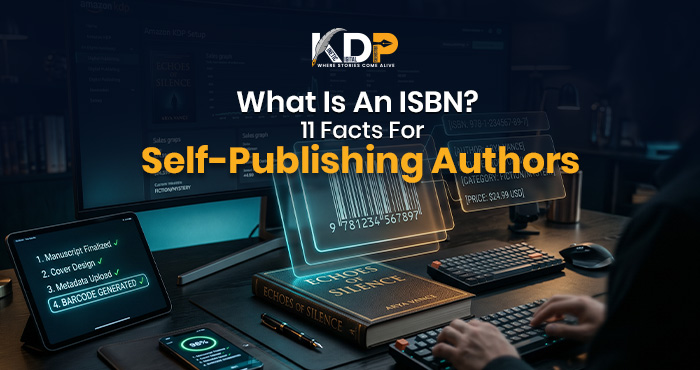
What Is An ISBN? 11 Facts For Self-Publishing Authors
Once you are set to publish your book, the ISBN will be the first term you come across. It stands for International Standard Book Number, a 13-character code that becomes your book’s identification number in the world of publishing.
As you release any form of your book—paperback, hardcover, or even eBook—the knowledge of an ISBN becomes mandatory. Most self-publishing authors who release their books for the first time are confused about ISBNs, but once you understand them, things get easy.
If you want assistance in publishing your book as soon as possible, then you should consider our services at Kinetic Digital Publishers, where we take care of everything, including registration of the ISBN.
In this article, you will learn:
- What an ISBN actually is
- Who needs an ISBN
- Whether different formats need separate ISBNs
- If you can recycle or reuse an ISBN
- How ISBNs are issued and assigned
- Who ISBNs are issued to
- The disadvantages of publishing without an ISBN
- Whether your eBook needs an ISBN
- The difference between ISBNs and barcodes
- What every digit in an ISBN actually means
- What Is an ISBN? The Full Meaning Explained
ISBN stands for International Standard Book Number. The number serves as an international identifier for every edition and variant of a book that has been published worldwide. Just like fingerprints, no two books have identical ISBNs.
Today’s ISBN consists of 13 digits, which are split into five segments using hyphens. Previously, ISBNs had only 10 digits. Once the International ISBN Agency ran out of digits, they added a prefix consisting of three digits (978 or 979) at the beginning of the sequence. As a result, today’s standard includes 13 digits.
Interesting Fact: An ISBN doesn’t provide you with copyright protection. The processes of registering copyrights and ISBN numbers are completely different. The former registers your book; the latter protects its contents.
By including an ISBN on all your books’ copies, you make it easier for distributors, booksellers, libraries, and Internet sellers to identify your book without any problems. This way, if someone wants to buy a certain edition of your book, they will not be able to purchase an incorrect version by mistake.
- Who Needs an ISBN?
Any publisher, including the self-publisher, that releases their book in print form requires an ISBN. An ISBN is crucial for ensuring that your book gets into catalogs, database listings, and even online book shops.
Do all books have an ISBN? Not all books require an ISBN. All printed books need an ISBN, but eBooks and audiobooks that can be downloaded are not always required to have an ISBN.
If you plan on distributing your book using the digital format, you do not require an ISBN for distribution on these key websites:
- Amazon Kindle
- Barnes & Noble Nook Press
- Apple iBooks
- Kobo
- Google Play Books
- Smashwords/Draft2Digital
Should Self-Published Authors Buy Their Own ISBN?
This is perhaps one of the most contentious issues when it comes to self-publishing. The truth of the matter is: It all depends on your self-publishing objectives.
If you choose print-on-demand sites like Amazon KDP, then they will provide you with a free ISBN; however, they will publish your book with their name or the name of “Independently Published.” But if you get yourself an ISBN directly through the ISBN agency in your country, then your name will appear as the publisher.
Reasons NOT to Purchase an ISBN
- You want to minimize upfront costs
- You mainly sell books online (Amazon, eBook platforms)
- You’re publishing for a niche audience or personal project
- Platform-assigned ISBNs cover your distribution needs
Reasons TO Purchase an ISBN
- You want to build your own publishing brand or imprint
- You plan to distribute to physical bookstores and libraries
- You want to appear as a professional independent publisher
- You want full control over metadata across all platforms
Key point to remember: Some indie bookstores and libraries may be hesitant to sell or order books bearing the publishing imprint of Amazon. Should you decide to distribute your book physically, having an ISBN number will definitely help you out a lot.
- Do Different Publishing Formats Require Separate ISBNs?
Indeed, every format of your book needs a different ISBN.
The following is a list of instances in which an ISBN is mandatory:
- Paperback version → requires a unique ISBN
- Hardcover version → requires a unique ISBN
- eBook version → requires a unique ISBN (though optional)
- Audiobook version → requires a unique ISBN (if distributed outside of major platforms)
- Revised / Second Editions → require new ISBNs for each respective edition
Note: If you are reprinting a hardcover version of a book without making any changes to the book at all, you do not have to get a new ISBN. However, any change you make to the book will require a new ISBN number.
- Can You Recycle or Reuse an ISBN?
- It’s impossible to recycle or reuse the ISBN. Once it is assigned to a certain book edition, then it stays there forever, regardless of whether your book remains in print or not.
If you decide to make changes to your book and produce another edition of it, you will have to apply for a totally new ISBN. This requirement is needed to guarantee the accuracy of the global books identification system.
That’s why buying an ISBN pack is always a good idea. The price per single ISBN becomes lower when you buy more of them; for example, it will cost much less to buy a 100-ISBN package than to acquire each ISBN separately.
- How Are ISBNs Issued and Assigned?
ISBNs are distributed by the ISBN national agency of each individual country. The international ISBN agency is responsible for managing the worldwide system.
The following is a list of key countries:
- USA & Australia: R.R. Bowker (myidentifiers.com)
- United Kingdom & Ireland: Nielsen Book Services
- Canada: Library and Archives Canada (free for Canadian publishers)
- South Africa: National Library of South Africa
- India: Raja Rammohun Roy National Agency for ISBN
There are some countries that give ISBNs to publishers for free; Canada is one such country. Publishers of the USA, on the other hand, have to buy their ISBNs from Bowker.
- To Whom Are ISBNs Issued?
In a technical sense, ISBN numbers are given to publishers. However, since you are a self-publisher, you yourself become the publisher; thus, you will be able to obtain the ISBN number in your own name or under your publishing house.
If you get a free ISBN from one of the print-on-demand websites, such as Amazon’s KDP, then the print-on-demand website or the term Independently Published will appear as the publisher in the database of the book that you published. Note that this in no way affects your royalties or copyrights, although your publishing professionalism may be questioned.
Pro tip from KDP: In case you want to create an author’s brand, then we recommend creating your own publishing house name and buying ISBN numbers under it. It only costs a few dollars, and it shows your professionalism and commitment. We can help you do this at our company.
Now, what about the ISBNs for magazines? In this case, you need to know that there are other numbers for serially produced publications. These numbers are called the ISSN (International Standard Serial Number).
- Disadvantages of Publishing Without an ISBN
While publishing a digital book without an ISBN is technically possible on most major platforms, there are real drawbacks to consider:
- Reduced discoverability: Books without ISBNs are harder to find in library catalogs, book databases like Books in Print, and academic directories.
- Limited distribution options: Some distributors and retailers require an ISBN to accept your title. Without one, your reach is narrowed.
- Harder sales tracking: ISBNs enable cross-platform sales tracking. Without one, monitoring how your book performs across different channels becomes difficult.
- Perceived lack of professionalism: A book without an ISBN may raise red flags with bookstores, reviewers, and media outlets.
- Exclusion from print editions: If you want a physical version of your book, you will need an ISBN — there is no workaround for print distribution.
- How Do You Get an ISBN?
Getting an ISBN is fairly simple. Below is how it is done for US-based authors:
- Go to myidentifiers.com (the official ISBN site of R.R. Bowker)
- Register a free account as a publisher
- Buy either one ISBN ($125) or ten ISBNs ($295); the latter provides more savings
- Provide information about your book (title, author, format, et al.)
- Receive your ISBN immediately through email
- Submit your title to the Books in Print Database
Tip for budget-conscious authors: Unless you plan to produce only one book in one format (i.e., only one eBook), then the best choice will be buying the pack of 10, which amounts to just $29.50 per ISBN — rather than buying each ISBN for $125 each!
For authors who do not reside in the United States, it would be best to contact their country’s ISBN agency since many countries provide ISBNs for free or at a lower rate.
Another option is using services provided by a full-scale book publisher, such as Kinetic Digital Publishers, where we take care of everything, including the registration of your ISBN.
- Does My eBook Need an ISBN?
Not necessarily — but it depends on your distribution strategy.
Almost all of the major eBook platforms do not require an ISBN to publish your work. Amazon Kindle, Apple Books, Google Play, Kobo, and Barnes & Noble can publish your eBook without having an ISBN. Each platform has its own identification system to identify your eBook, such as Amazon’s ASIN.
Some of the reasons why you should obtain an ISBN for your eBook are:
- Your eBook should be listed in the library catalog and OverDrive, the leading library eBook platform.
- If you are using any aggregator to distribute your eBooks widely, you need an ISBN.
- You want to keep track of metadata for all platforms.
- You are planning to submit your book to award nominations.
- ISBNs vs. Barcodes — What’s the Difference?
Authors frequently confuse ISBNs with barcodes, but they serve different purposes — even though they are closely related.
ISBN
- A 13-digit number that identifies your book
- Appears on the copyright page inside the book
- Used in databases, catalogs, and distribution systems
- Required for distribution
Barcode
- A scannable visual representation of that number
- Appears on the back cover of the book
- Used by retailers to scan and process sales at the point of purchase
- Required for physical retail sales
A standard book barcode (EAN-13 format) encodes the 13-digit ISBN. It may also include a 5-digit “add-on” barcode that encodes the book’s retail price. If you’re formatting your own book, you’ll need to generate a barcode separately — the ISBN alone is not a barcode.
You can generate a free ISBN barcode using Kinetic Digital Publishers’ free ISBN Barcode Generator tool — no account required.
- The Meaning of Each Part of an ISBN Number
Each and every ISBN number is a story of the book that it stands for. There are five sections of the 13-digit ISBN, and each holds information as follows:
- EAN Prefix (978 or 979): The first three digits in the series are the EAN (European Article Number). All current ISBNs start with either 978 or 979. The 979 EAN was adopted when the 978 pool started to get too crowded.
- Registration Group Identifier (1 to 5 digits): Registration Group Identifier refers to a particular country, geographic territory, or language community within which the publisher is located. In English Language Publishers, identifiers are “0” and “1”.
- Registrant Element (variable length): This section is the identification of the specific publisher, self-publisher, or author who is responsible for the publishing process. Publishers who have a large number of books use shorter Registrant Elements because they require space in the Publication Element.
- Publication Element (variable length): This part is the identification of the specific publication. Different versions of the same book are assigned different publication elements.
- Check Digit (1 digit): The last digit is the check digit, which is a mathematically calculated value based on the first 12
The Final Word
ISBNs may seem daunting initially, but they simply serve as a straightforward identifier for your book. Some things to remember include securing a different ISBN for each format in which you will be publishing your book, possibly buying your own if you wish to see your book in bookstores and libraries, and NEVER trying to use the same ISBN twice!
If you have decided to move forward and have your book published with professional assistance, including ISBN registration, cover creation, and marketing, please allow us at Kinetic Digital Publishers to assist you.